Key Takeaways
- Grayanotoxins are natural compounds made by certain rhododendrons and carried into mad honey by bees.
- Of more than 25 known forms, grayanotoxin I and grayanotoxin III are the ones that matter most in mad honey.
- Grayanotoxin keeps the body's sodium channels open longer than usual, slowing nerve and muscle signalling.
- The same mechanism behind the calm people describe at small servings causes unpleasant symptoms at larger ones.
- Grayanotoxin levels differ from batch to batch, so lab testing is the only way to know how strong a jar is.
Mad honey's name, reputation, and the way it makes people feel all trace back to one family of plant compounds. Understanding them is the simplest way to understand mad honey itself.
Grayanotoxin in mad honey is a group of natural compounds that bees collect from the nectar of certain rhododendron flowers. Once eaten, grayanotoxins act on sodium channels in nerve and muscle cells, keeping them open for longer than usual. That's why a small amount of mad honey can bring on a calm, slowed-down feeling, while a larger amount can cause dizziness, nausea, or a slow heart rate.
Grayanotoxin: The Plant Chemistry Behind Mad Honey
Grayanotoxins belong to a group of plant compounds called diterpenes. In simple terms, they're ring-shaped molecules made of carbon, hydrogen, and oxygen. Unlike many better-known plant toxins, such as caffeine or nicotine, they contain no nitrogen, so they aren't alkaloids. Chemically, they're a class of their own.
Plants in the heather family produce grayanotoxins, and certain rhododendrons are the best-known source. Similar plant compounds are often thought to help protect the plant from grazing animals, though for grayanotoxins that role isn't fully understood.
Scientists have identified more than 25 different forms of grayanotoxin. Most of them are present only in tiny amounts, or not at all, in honey. Two forms stand out: grayanotoxin I and grayanotoxin III, often shortened to GTX I and GTX III. These are the main active forms in mad honey, and they're the ones a lab measures when testing a batch. They're what sets mad honey apart from ordinary honey.
How Grayanotoxin Gets Into Honey
Grayanotoxins are found in several parts of the rhododendron plant, including the flowers. When bees forage on rhododendron blossoms, they collect nectar that contains grayanotoxins and carry it back to the hive. As the nectar is turned into honey, the grayanotoxins pass into the finished honey largely unchanged.
In Nepal, Himalayan giant honey bees forage on the rhododendrons that flower on Himalayan slopes in spring, which is why the spring harvest is the one associated with mad honey.

Why Grayanotoxin Levels Vary From Jar to Jar
Mad honey isn't made to a recipe, so no two harvests are exactly alike. Several natural factors shape how much grayanotoxin ends up in the honey:
- Plant species: Rhododendron species differ in how much grayanotoxin their nectar contains.
- Altitude: The mix of plants changes with elevation, and so does what the bees forage on.
- Season and weather: A cold or wet spring can change how densely the rhododendrons flower and how long the bees spend on them.
- The rest of the forage: Bees rarely feed on a single plant, and nectar from other flowers dilutes the grayanotoxin content.
The result is that two jars can look, smell, and taste much the same while differing a lot in strength. Colour, thickness, and bitterness don't reveal grayanotoxin levels. Only testing does.
How Grayanotoxin Works in the Body
Here is a breakdown of the processes behind the calming feeling mad honey can bring at small doses.
Sodium Channels, the Body's Electrical Gates
Every nerve and muscle cell in the body relies on electrical signals. Those signals are controlled by tiny gates in the cell wall called sodium channels. When a gate opens, sodium flows into the cell and a signal fires. The gate then closes, and the cell resets, ready for the next signal.
Grayanotoxin attaches to these gates while they're open and stops them from closing properly. The cell stays partly "switched on" for longer than it should, and signalling across the body slows down.
The Nervous System and a Slower Heart Rate
Grayanotoxin also seems to work on the "rest and digest" side of the nervous system, the part that slows your heart after a fright or a big meal. Researchers think this, together with the sodium channel effect, helps explain why mad honey can lower heart rate and blood pressure.
Why Small Amounts Feel Calm
At a small serving, that slowing seems to show up as the calm, settled feeling people describe. Many also notice a light, warm sensation at the back of the throat soon after swallowing. That's partly down to mad honey's taste, which is slightly bitter and can tingle in the throat in a way ordinary honey doesn't.
Researchers don't fully understand why small amounts of grayanotoxin feel calming rather than simply heavy, and effects vary a lot between people. Some feel it clearly, while others notice very little.
How Long Grayanotoxin Stays in the Body
After a typical serving of one teaspoon, effects usually begin within 15-60 minutes and last 1-4 hours. The body then breaks down and clears the grayanotoxin naturally. Even when someone has taken too much, symptoms usually don’t last longer than a day.
| Stage of grayanotoxin's effect | What grayanotoxin does | What people may notice |
|---|---|---|
| Right after eating honey with grayanotoxin | The gut starts absorbing grayanotoxin | A slightly bitter taste and a warm feeling in the throat |
| Grayanotoxin at the sodium channels | Grayanotoxin holds sodium channels open, slowing nerve and muscle signalling | A gradual sense of slowing down |
| Grayanotoxin in the nervous system | Grayanotoxin appears to boost the signals that slow the heart rate | A calmer, more relaxed state |
| Grayanotoxin as the body clears it | The body breaks down and removes grayanotoxin | Effects fade, usually within 1-4 hours |
How Grayanotoxin's Effects Change With Dose
With grayanotoxin, more isn't better. Its effects follow a dose curve with no plateau. A larger amount strengthens every effect, including the drop in heart rate and blood pressure.
At a small serving, that shows up as a gentle slowing down. At a larger one, the same mechanism can bring on dizziness, nausea, sweating, weakness, and a noticeably slow heart rate. These symptoms usually ease on their own within a few hours, but anyone who feels faint, experiences chest pain, or notices a very slow heartbeat should get medical help and say they've eaten mad honey. The details of what happens if you take too much mad honey are worth knowing before a first try.
This is why patience is so important. Grayanotoxin builds up in your bloodstream slowly. If you take a second serving before the first one peaks, you can end up with far more than you intended. Give it 45–60 minutes before even considering more.
How Grayanotoxin Is Measured in Mad Honey
Since grayanotoxin can't be seen, smelt, or reliably tasted, a laboratory test is the only way to know how much a batch contains. This makes testing the most important safety step.
To test a batch, a lab takes a sample and runs it through liquid chromatography, which separates the honey into its individual compounds. A mass spectrometer then identifies grayanotoxin I and grayanotoxin III and measures exactly how much of each is present. The results are usually given as an amount of grayanotoxin per gram or kilogram of honey.
A useful lab report should:
- Belong to one specific batch
- Show separate figures for GTX I and GTX III
- Carry a batch number you can match to the number on your jar
Checking for these three things is also one of the quickest ways to compare mad honey brands in the UK, since not every seller publishes batch-level results.
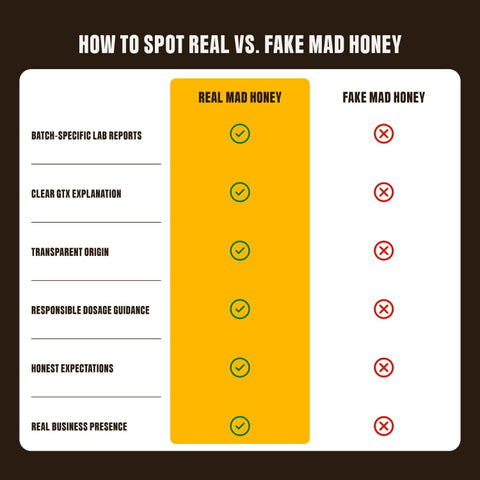
Each batch of our honey is tested by an independent laboratory, and we publish the results in our batch lab reports. Batches that come back outside our safe limits or that look inconsistent are rejected. Every jar of our lab-tested Himalayan mad honey can be traced back to its report so you know what you're getting before you open it. Testing is also the most reliable way to distinguish real mad honey from fakes.
Final Thoughts
Grayanotoxin is the reason mad honey is mad. It's a natural plant compound that slows the body's electrical signalling, and at a small serving, people describe that as a calm, warm, slowed-down feeling. At a larger serving, the same mechanism goes too far. The difference comes down to two things: how much grayanotoxin is in the jar and how much of it you take.
Understanding grayanotoxin takes some of the mystery out of mad honey without taking away any of its fascination. It's a compound that travels from Himalayan rhododendrons, through the work of wild cliff bees, all the way into a jar on your shelf.