Key Takeaways
- Grayanotoxin isn't one of the substances that standard drug tests screen for.
- Grayanotoxin is a natural plant compound, chemically unrelated to the drugs on a typical test panel.
- A lab could detect grayanotoxin if it looked for it specifically, but that's rare outside hospital or research settings.
- A clear test result doesn't mean you're fit to drive or work while you can feel mad honey's effects.
- Untested products from unknown sellers may not contain only what's on the label.
If your job involves drug testing, or you simply like to know what you're putting in your body, it's a fair question to ask before trying mad honey. The good news is that the answer is fairly straightforward.
Mad honey shouldn't show up on a standard drug test. They typically look for specific groups of drugs, such as cannabis, cocaine, opiates, and amphetamines. Grayanotoxin, the natural compound behind mad honey's effects, isn't one of them. A specialist lab could detect grayanotoxin if it was asked to look for it, but that's very rarely part of routine testing.
What Standard Drug Tests Look For
Drug tests don't search for "anything unusual" in your body. Each test is designed to pick up a fixed list of substances, or the compounds the body turns them into. If a substance isn't on that list, the test isn't looking for it.
In the UK, most workplace testing uses urine or saliva samples, screening for common drug groups such as cannabis, cocaine, opiates, amphetamines and benzodiazepines. Roadside drug tests used by the police are narrower and mainly check for cannabis and cocaine. Blood tests at a police station or in a hospital can look for a wider range of substances, but they still need to be set up to search for something specific.
| Type of drug test | What the drug test looks for | Is mad honey part of the drug test |
|---|---|---|
| Workplace urine drug test | Common drug groups such as cannabis, cocaine, opiates, amphetamines, and benzodiazepines | No, grayanotoxin isn't on standard workplace panels |
| Saliva drug test | Recent use of similar common drug groups | No, grayanotoxin isn't on standard saliva panels |
| Police roadside drug test | Mainly cannabis and cocaine | No, grayanotoxin isn't screened for at the roadside |
| Police or hospital blood test | A wider range of drugs, including some prescription medicines | Potentially, grayanotoxin would only be found if the lab tested for it specifically |
| Specialist toxicology test | Any compound a lab is specifically asked to identify | Yes, grayanotoxin can be detected with specialist methods, but this is rarely requested |
Why Mad Honey Doesn't Trigger a Standard Drug Test
Grayanotoxin belongs to a group of plant compounds called diterpenes. Its structure has nothing in common with opiates, cannabinoids, stimulants, or sedatives, so the tests built to recognise those drugs have no reason to react to it. In short, grayanotoxin, the compound behind mad honey, is chemically a class of its own.
Mad honey is also sold as a food. Grayanotoxin isn't a controlled substance, and mad honey's legal status in the UK reflects that.
What about false positives? Some foods are known to cause them. Poppy seeds, for example, can trigger a positive result on opiate tests because they carry traces of related compounds. Honey isn't known to cause false positives, and there's no chemical reason grayanotoxin would be mistaken for the drugs on a standard panel. Still, no one can promise how every test, from every provider, will behave in every case.
Can Grayanotoxin Be Detected at All
Yes, but only when a lab goes looking for it. Specialist techniques, such as liquid chromatography combined with mass spectrometry, can identify grayanotoxin in blood, urine, or honey samples. This kind of testing is used in research and for checking honey itself and occasionally in hospitals when doctors suspect someone has eaten too much mad honey. Even then, many hospitals don't offer it routinely.
Grayanotoxin also doesn't hang around for long. After a typical serving, effects usually last 1-4 hours, and the body breaks down and clears the compound naturally after that.
Mad Honey, Work and Driving
A clear drug test isn't the same as being fit to drive or work. Mad honey can leave you feeling slowed down, and if you take too much, it can cause dizziness and a slow heart rate. Those effects matter far more than whether a test would pick anything up.
In the UK, it's an offence to drive while unfit through drugs, and that isn't limited to illegal ones. A driver who's visibly impaired can be stopped and assessed by the police, whatever caused it. This isn't legal advice, but the practical rule is simple: don't drive while you can feel mad honey's effects, and leave plenty of time before getting behind the wheel.
The same goes for work. Don't take mad honey before a shift, before operating machinery, or before anything that needs your full attention. Save it for a quiet evening at home, with nothing important planned for the rest of the day.
If you're ever asked by an employer or a doctor what you've taken, be honest. Mad honey is a legal food, and telling a doctor you've eaten it helps them understand any symptoms quickly.
Why Tested Mad Honey Matters
The answer to "Will it show up on a drug test?" assumes your jar contains mad honey and nothing else. With untested products from unknown sellers, you can't be sure of that. Without a lab report, there's no way to know what a jar really contains or how strong it is.

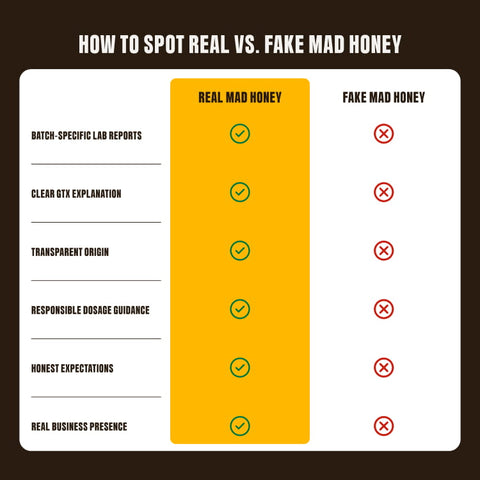
We have every batch of our honey tested by an independent laboratory, and we publish the results in our batch lab reports. Batches that come back outside our safe limits or look inconsistent are rejected. Every jar of our lab-tested mad honey can be matched to its report, which is also one of the clearest signs of mad honey authenticity.
Final Thoughts
Mad honey shouldn't show up on a standard drug test, because grayanotoxin simply isn't what those tests are looking for. Workplace and roadside tests screen for a fixed list of drug groups, and a specialist lab would only find grayanotoxin if someone asked it to look.
The more important question is when you take it. Treat mad honey as something for a quiet evening at home, never before driving or at work, and the drug test question rarely comes up at all. If a doctor or employer ever asks what you've taken, a straight answer is always the best one, since mad honey is a legal food with nothing to hide. Choosing mad honey from a reputable seller that provides a batch lab report is the simplest way to enjoy it with peace of mind.