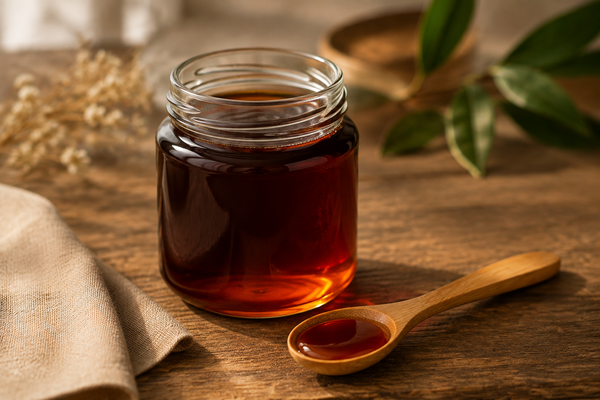
Real mad honey is honey that carries grayanotoxins from rhododendron nectar in high enough concentration to have an effect. That single measurable fact is what makes it real, and everything else attached to a jar, meaning its colour, its origin story, its price and its packaging, is compatible with honey that contains none at all.
That matters because nothing enforces the definition. There is no protected designation for mad honey, no compositional standard a jar must meet, and no requirement anywhere that a seller prove what is inside, which means the words can be printed on any honey at all. Telling real from fake therefore comes down to chemistry and to the evidence a seller is willing to show.
What Real Mad Honey Contains
Three things have to be true at once for those compounds to end up in a jar at any useful level. The nectar has to come from rhododendron species that produce them, the bees have to have worked those flowers heavily enough for the compounds to carry through in quantity, and nothing can have been added afterwards to bulk the honey out.
The first and third are straightforward. The second is where most jars fail, and it is the condition almost nobody checks. A colony foraging a hillside where grayanotoxin-bearing rhododendrons are only part of the available bloom produces honey that contains traces of the compounds and delivers nothing. That honey is genuinely rhododendron-derived and honestly described in every botanical sense, and it is still not what a buyer paying a premium is paying for. Presence is not the test. Concentration is.
This is why the definition has to be chemical rather than descriptive. Every other quality a jar might have, meaning its colour, its bitterness, its region, its price, and the story behind its harvest, is equally available to honey that would fail the test. The only thing that distinguishes real mad honey is how much grayanotoxin is actually in it, which is a number rather than a characteristic. A fuller account of what mad honey is and how it differs from ordinary honey covers the compounds themselves in more detail.
Where Authentic Mad Honey Comes From
Grayanotoxin-bearing rhododendrons grow in relatively few places at the density required, which narrows the field considerably. The Himalayan belt through Nepal is the origin most associated with the honey, where wild colonies build on exposed cliff faces and forage on mountain rhododendrons during a short spring flowering. The Black Sea region of Turkey is the other established source, where different rhododendron species grow across forested slopes. The full picture of where mad honey comes from covers both in more detail.
Provenance functions as evidence rather than as a guarantee. A named valley, a stated harvest window, and an identified harvesting community are claims that can be checked and, if false, contradicted. A jar described only as Himalayan or mountain-harvested makes no checkable claim at all, since those words describe a large portion of Asia and commit the seller to nothing.
The limits are worth stating plainly. Honey from the right region is not automatically potent, since not every colony in Nepal forages predominantly on rhododendrons, and honey from a named valley can still be blended with something else before it reaches a jar. Origin narrows the possibilities. It does not close them.

Why Two Genuine Jars Are Never Identical
Consistency is the wrong thing to look for. Grayanotoxin concentration is set in the field by which rhododendron species dominated the forage, how densely they flowered, the elevation of the colony and the weather across the season, and none of those repeats exactly from one year to the next. Two harvests from the same valley can differ substantially, and both are entirely genuine.
This has a counterintuitive consequence. A seller whose product is identical batch after batch, in colour, in flavour and in reported strength, is describing something that a wild seasonal harvest does not produce naturally. Consistency at that level implies blending, processing or standardisation of some kind, which is precisely what separates an agricultural product from a manufactured one.
Variation, in other words, is a mark of authenticity rather than an excuse for it. Two jars from the same valley in different years are both real, and a range of strengths within an honest supply is normal. What that does not explain is a jar with nothing in it at all, which is a different problem entirely.
How to Spot Fake Mad Honey
Fake covers four different things in this category, and they are not equally easy to catch.
| Type of fake | How common | How it is detected |
|---|---|---|
| Honey with little or no grayanotoxin | The most common by a wide margin | Nothing visible, and often no effect at any amount. Only a GTX report settles it |
| Genuine mad honey cut with ordinary honey | Common where supply runs short | A weaker response than the description implies, detectable only by measured concentration |
| Honey adulterated with sugar syrup | The standard fraud across the whole honey trade | Carbon isotope analysis, which is a separate test from grayanotoxin quantification |
| Honey with something added to mimic an effect | Rare, and the most serious | Effects that do not match the described profile. No routine honey test looks for it |
The first two are failures of content, the third is a failure of purity, and the fourth is something else altogether. Only the first is what most buyers have in mind when they worry about fakes, and it is also the one a published report resolves outright.
Spotting any of them starts with knowing which signals to set aside. Colour varies with floral source, storage and age, so a dark jar is not a strong one and a pale jar is not a weak one. Thickness reflects moisture content. Crystallisation is normal in raw honey and indicates neither age nor adulteration. Bitterness comes from the botanical source, but it can be present in honey with negligible grayanotoxin content and is also the easiest characteristic to imitate. These describe the honey rather than test it, which is why the useful checks lie elsewhere.
The one physical sign worth anything is the throat sensation. Genuine mad honey taken by the spoonful usually produces a light tingling on the lips and tongue within a minute or two, followed by a faint catch or warmth at the back of the throat. Its absence is meaningful and suggests very little active content. Its presence is encouraging rather than conclusive, since it indicates the compounds are there without saying how much.
The absence of any effect is the signal most buyers end up relying on, and it is the worst one available, because it only arrives after the money is spent and can be explained by a mild batch or low individual sensitivity as easily as by fraud.
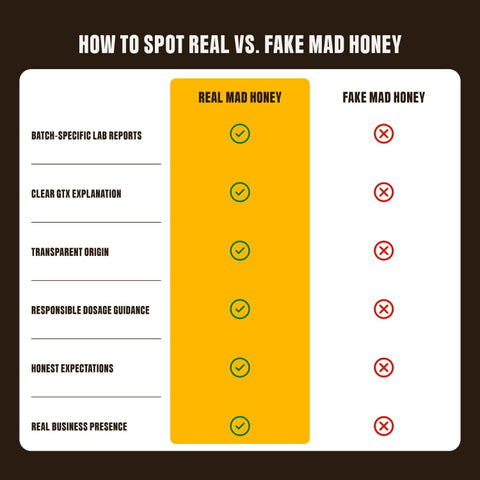
What actually works is checking the seller before the jar. Four things are worth confirming:
-
A published laboratory report with a sample reference that matches the batch on sale
-
A testing date recent enough to correspond to a current harvest rather than an older one
-
A named harvesting region and season, not a country or a vague mountain reference
-
Conservative serving guidance rather than claims about extreme strength
None of those requires trusting the seller's judgement. They are all verifiable on the product page before anything is bought, which is more than can be said for anything visible in the jar itself.

How Genuine Mad Honey Is Verified
No single laboratory test settles authenticity, which is why a report carrying one figure should be read carefully. Different methods answer different questions, and each has a blind spot the others cover.
Grayanotoxin quantification is the test that matters most here, and for mad honey it is the test that matters at all. It measures how much GTX I and GTX III a sample contains and establishes whether a jar is mad honey rather than rhododendron honey with nothing in it. Other laboratory methods exist for other questions, such as confirming botanical origin or detecting added syrup, but none of them answers the question a mad honey buyer is actually asking.
The scale of the problem in this category is documented. A study of sixty Nepalese mad honey samples found measurable grayanotoxin in only thirty-three of them, so close to half carried the name and contained nothing worth paying for. That is a failure rate no description on a label would ever reveal.
For mad honey specifically, the grayanotoxin figure is the number that decides whether a jar is what it claims to be, and it is the one a seller should be publishing.
How to Read a Batch Report
A report is only useful if it can be matched to the jar being bought, and checking that is easier than it sounds. The sample reference should correspond to the batch code on the jar or the product page, and the date should be recent enough to describe a current harvest, since mad honey is collected in short seasonal windows and a report from several years back is not describing what is in stock now.
The figures themselves are the substance. GTX I and GTX III are the two compounds normally measured, and seeing both is better than seeing one, since a single figure gives only a partial picture. The numbers usually come in micrograms per kilogram, written µg/kg, and they matter less as an absolute than as a comparison, because they allow one batch to be set against another and a seller's serving guidance to be checked against what the honey actually contains.
A full report will also name the method used, typically LC-MS for these compounds, and show the dates the analysis began and ended. Who did the work matters just as much. A named independent laboratory has its reputation attached to the result, while a report on a seller's own letterhead with no laboratory identified is a statement rather than evidence.
What a Trustworthy Seller Provides
A seller can be judged before the honey is, and the report is only part of it. Three other things separate the credible from the rest: a named harvesting community rather than a supply chain that stops at a border, serving guidance conservative enough to suggest they expect the honey to work, and a real business behind the transaction with contact details and a returns policy.
The last of those matters more than it sounds. A seller with no recourse attached to a purchase is asking for a payment rather than making a sale, and it is the easiest of the three to check.
Real Mad Honey meets all of that. Its honey is wild-harvested above 3,500 metres in the Himalayas through established Nepalese honey-hunting communities, collected during the short seasonal windows when the rhododendrons bloom. Every batch is analysed by Eurofins for GTX I and GTX III before sale, with the results published against the batch on the shelf rather than summarised, and batches falling outside the accepted standards are rejected instead of being blended away or discounted.
Each jar ships with clear serving guidance, and each harvest keeps its own character rather than being presented as identical to the last, which is what an honest account of a wild product looks like.

Takeaway: How to Tell Real From Fake
Real mad honey is defined by one measurable thing, which is the presence of grayanotoxins in meaningful concentration, and by nothing else. Everything a buyer can see, taste, or read on a label is compatible with honey that contains none at all, which is why close to half the samples in one Nepalese study carried the name and failed the test.
The practical position follows from that. Appearance and price are worthless as evidence, the throat sensation is suggestive at best, and provenance narrows the field without settling it. What settles it is a laboratory report tied to the specific batch on sale, which is the one piece of evidence a buyer can examine before spending anything.
A genuine seller has that report and shows it. A seller who does not is asking for trust in a word that nothing legally obliges them to earn.