Key Takeaways
- Mad honey comes from a handful of Himalayan rhododendrons, not from rhododendrons in general.
- The red rhododendron, known locally as lali gurans, colours Nepal's hillsides every spring.
- The spring bloom moves up the mountains with the season, and it decides when mad honey can be harvested.
- Our honey comes from high mountain slopes where the right rhododendrons grow in dense stands.
- Many UK rhododendrons have Himalayan roots, but they don't produce mad honey.
If you've walked through a park or country garden in May, you've almost certainly seen a rhododendron. Some of them are distant relatives of the flowers behind mad honey, brought from the Himalayas more than 150 years ago.
The mad honey rhododendron is one of a small number of Himalayan species whose nectar contains grayanotoxins. When Nepal's giant cliff bees forage on these flowers in spring, the grayanotoxins pass into their honey, giving mad honey its strength and its name. The flowers themselves, where they grow and when they bloom, shape every jar.
Lali Gurans, Nepal's National Flower
In Nepal, the rhododendron is more than a mountain shrub. The red rhododendron, called lali gurans in Nepali, is the country's national flower, and it appears in Nepal's coat of arms.
Unlike the neat shrubs in our gardens, lali gurans often grows into full trees, with gnarled trunks and branches covered in moss. On the trails of the middle hills, walkers pass through forests of it, and for many Nepalis, its flowering is one of the first signs that winter is over.
The Rhododendrons Behind Nepali Mad Honey
Lali gurans is Nepal's best-loved rhododendron, but it's only one of dozens that grow across the country, and only some of them are linked to mad honey.
The Role Rhododendrons Play in Mad Honey
Bees make mad honey in the same way they make any other honey. They collect nectar, carry it back to the hive, and turn it into honey over time. What makes the difference is the nectar itself. Certain rhododendrons produce grayanotoxin, the compound behind mad honey, and it passes from their nectar into the finished honey largely unchanged.
But rhododendrons are a huge family, with hundreds of species worldwide and dozens in Nepal alone. Only some of them carry grayanotoxin into their nectar in meaningful amounts, and even among those, the levels vary with the species, the location, and the time of year.
Researchers haven't yet pinned down exactly which Himalayan species contribute most to Nepali mad honey, and accounts differ. Some point to the paler, white-flowering rhododendrons that grow higher up the slopes, closer to the treeline, where the cliff bees forage in spring.
Not every rhododendron on a mountainside contributes to mad honey, and the mix of species changes from valley to valley. That's one reason honey from the same region can still vary from one harvest to the next.
Where They Grow: Altitude and Conditions
The rhododendrons behind mad honey grow on steep Himalayan slopes, in cool, damp mountain forests where they form dense stands. That density is important. When a whole hillside flowers at once, the bees have little reason to look elsewhere, and rhododendron nectar makes up a large share of what they collect.
These are also the slopes where the Himalayan giant honeybee builds its huge nests on sheer cliff faces. The bees, the cliffs, and the rhododendron forests all sit in the same high, remote landscape.
Altitude alone doesn't make mad honey, though. It also depends on which rhododendrons grow on the slope, how heavily they flower, and what else is blooming nearby.
How the Spring Bloom Shapes the Harvest
Nepal's rhododendrons don't all flower at once. The bloom starts on the lower slopes as the weather warms, then moves gradually uphill over the following weeks. The bees follow it, foraging on each band of flowers as it opens.
This short, rising bloom is why mad honey is a spring honey, harvested once a year. Once the rhododendrons have finished flowering, the bees move on to other plants, and the honey they make changes with them. Nepal's honey hunters time their harvest around this window, gathering the honey from the cliffs once the spring forage is complete.
And because mad honey depends on wild flowers, no two harvests are quite the same. The mix of species, the strength of the bloom, and the weather all shape its colour, its flavour and, most importantly, its grayanotoxin level.
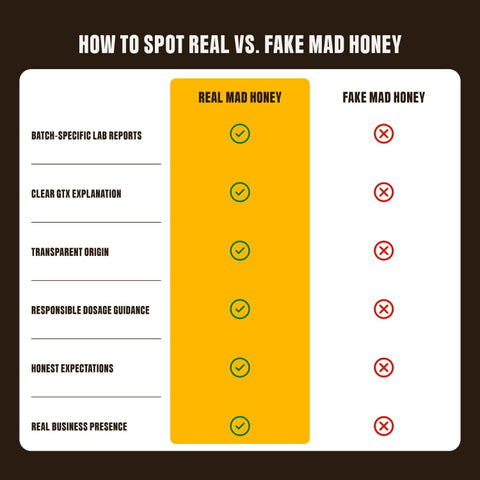
That's why we test every batch on its own and publish the results in our batch lab reports. Every jar of our lab-tested Himalayan mad honey can be matched to its report, so you always know the strength of your honey.
How Rhododendrons Came to Britain
Britain's love of rhododendrons has deep Himalayan roots.
In the 1800s, Victorian plant hunters brought back seeds from the eastern Himalayas, and rhododendrons quickly became a fashion statement, with country estates planting whole valleys of them. Many of the large, colourful varieties in British gardens today descend from those introductions.
One species took to Britain a little too well, though. Rhododendron ponticum, introduced in the 1700s as an ornamental plant, spreads easily through seed and suckers, and it has since run wild across woodlands and hillsides, especially in Wales and western Scotland, where it's treated as an invasive species that crowds out native plants.
Himalayan and British Rhododendrons Compared
Rhododendrons might be blooming in your garden, but they won't give you mad honey.
| Feature of the rhododendron | Himalayan rhododendrons behind mad honey | Rhododendrons in British gardens |
|---|---|---|
| Where the rhododendrons grow | Wild forests on steep slopes in the Himalayas | Gardens, parks, estates and some woodlands |
| How the rhododendrons grow | Dense stands that cover whole hillsides | Mostly scattered shrubs, apart from invasive patches |
| Altitude of the rhododendrons | High mountain slopes | Mostly lowland |
| Bees that forage on the rhododendrons | The Himalayan giant honeybee, nesting on nearby cliffs | Honeybees and bumblebees with plenty of other forage |
| Grayanotoxin in honey from the rhododendrons | Enough to give mad honey its effects | Usually no meaningful amount |
| When the rhododendrons flower | A spring bloom that moves up the mountains over several weeks | Mainly late spring, around April to June |
Final Thoughts
Every jar of mad honey starts with a flower. In Nepal, that means rhododendron forests that turn the mountains red each spring, a bloom that climbs the slopes week by week, and wild cliff bees that follow it. Those flowers decide when the honey is harvested, how it tastes, and how strong it is.
The rhododendrons in British gardens share part of that story, often quite literally, through the seeds Victorian plant hunters carried home from the Himalayas. Here, though, they're simply beautiful shrubs. The honey that carries the rhododendron's strength still comes from the slopes where these flowers grow wild, and those slopes are exactly where Real Mad Honey comes from.