Taking more mad honey than intended produces an uncomfortable few hours rather than anything worse. The sensations are dizziness, nausea, and a general weakness; they come from the same mechanism that produces the pleasant effects at smaller amounts, and they resolve on their own without treatment in the great majority of cases.
That is worth knowing before it happens rather than during. Someone who understands what is occurring and roughly how long it will take tends to have a considerably easier time of it than someone who does not, and most of what helps is a matter of sitting still and waiting rather than doing anything active.

How Much Mad Honey Is Too Much?
There is no fixed threshold, which is the honest answer and also the reason this happens to people who thought they were being careful. Grayanotoxin content varies substantially between harvests, so the amount that produces a comfortable evening from one jar can be more than enough from another.
What can be said generally is that a teaspoon is a conventional serving and that problems cluster well above it. Accounts of difficulty almost always involve a tablespoon or more, several servings taken across a short period, or someone working through a jar rather than measuring from it.
Body weight, stomach contents, and individual sensitivity all shift the line further. The same amount affects a smaller frame more, an empty stomach produces a faster and sharper onset, and sensitivity varies enough between people that shared experiences make poor benchmarks.
The practical consequence is that too much is defined by the person and the jar rather than by a number. Where mad honey comes from explains why potency differs so much between harvests, which is what makes a tested jar considerably easier to judge than an untested one.
What Too Much Feels Like
The experience shifts from pleasant to uncomfortable rather than becoming a different thing entirely, which is what makes it recognisable. Dizziness and lightheadedness usually arrive first, along with a sense that standing up is harder than it should be. This comes from blood pressure dropping lower than intended, which is the same effect that produces the physical relaxation at smaller amounts.
Nausea often follows, sometimes with sweating and a clammy feeling. Weakness in the limbs is common, as is a sense of being unusually heavy or slowed down, and some people describe feeling cold despite sweating.
The heart rate slows rather than races, which surprises people expecting the opposite. Blurred vision and a general fuzziness can accompany it, though the sensation people most often report is simply wanting to lie down and stay there.
None of this is pleasant, and none of it is dangerous for most healthy adults. The symptoms are the mechanism taken further than intended rather than a reaction to something toxic in the usual sense.
How Soon It Comes On
The timing follows the same pattern as an ordinary serving, which is part of why people end up taking too much in the first place. Onset runs twenty to forty minutes on a relatively empty stomach and longer after a meal, sometimes over an hour. Nothing happens immediately, and the gap between taking the honey and noticing anything is where second servings tend to get taken.
The build is gradual rather than sudden. Effects deepen over the following half hour, which means discomfort arrives progressively rather than all at once, and there is usually enough warning to sit down and stop before it peaks.
Symptoms generally peak around one to two hours after the last serving. Where multiple servings were taken across a period, the peak arrives later and lasts longer, since each one is still being absorbed as the next takes effect.
What Helps in the First Hour
Most of what helps is passive, and the instinct to do something active is worth resisting. Five things make the wait considerably easier.
Lie Down and Stay There
The single most useful response. Blood pressure runs lower during the effects, so standing makes dizziness considerably worse, and staying horizontal removes the most common source of discomfort entirely.
Sip Water Steadily
This helps with comfort rather than with clearance. It does not speed anything up, though dehydration makes nausea worse and small amounts are easier to keep down than a large glass at once.
Eat Something Plain
Light carbohydrates settle the stomach and slow further absorption if any honey remains in it. Anything rich tends to make nausea worse rather than better.
Get Warm and Keep It Quiet
A blanket helps with the cold, clammy feeling, and low light with minimal noise makes the wait considerably more tolerable than trying to carry on with the evening.
Have Someone Nearby
Nothing about this usually requires intervention, though having someone who knows what was taken makes the experience less unsettling and means help can be called if anything changes.
When It Is Worth Getting Checked
Most cases resolve without medical involvement, and the ones that warrant attention are recognisable rather than ambiguous. Persistent vomiting is worth acting on, since it prevents fluids from staying down and dehydration compounds everything else.
Fainting, or coming close to it while already lying down, is a reason to seek advice rather than wait, as is a heart rate that feels unusually slow or irregular.
Chest pain, difficulty breathing, or confusion that deepens rather than settles all warrant medical attention promptly.
Symptoms that are still worsening after two hours rather than plateauing suggest more was taken than assumed, and getting checked is sensible at that point rather than continuing to wait.
Anyone with a heart condition, low blood pressure or on blood pressure medication should seek advice sooner rather than later, since the effects compound with those conditions in ways they do not for most people.
The useful thing to say on arrival is what was taken, roughly how much, and when. Grayanotoxin effects are well documented and straightforward to manage, and treatment is usually a matter of monitoring and supportive care rather than anything invasive.
How Long It Takes to Pass
The reassuring part of the picture is that this is self-limiting rather than something requiring intervention to resolve. Most symptoms settle within two to six hours of onset. The heaviest part passes first, usually within a couple of hours of the peak, and what follows is a gradual return to normal rather than a sudden shift.
Tiredness often outlasts everything else. Feeling drained for the remainder of the day is common, and sleep tends to come easily afterwards, which is one of the few advantages of the situation.
Recovery is generally complete by the following morning. Some people report mild grogginess the next day after a substantial overconsumption, though the lingering effects associated with alcohol are largely absent.
Nothing accumulates. Grayanotoxins clear rather than building up between servings, so an uncomfortable evening does not carry forward into the next time mad honey is taken.
What Makes It Last Longer
Four things extend an uncomfortable period that would otherwise pass reasonably quickly, and all four are within a person's control:
-
Taking more. The instinct to correct an unexpected experience by adjusting the amount makes it longer rather than shorter, since additional honey is still being absorbed while the existing discomfort continues.
-
Alcohol alongside it. Both lower blood pressure and affect coordination, and the combination produces something meaningfully worse than either alone.
-
Standing and moving around. Every attempt to carry on with the evening tends to produce another wave of dizziness, and the discomfort settles faster when the body is horizontal.
-
Nothing to eat. Nausea makes eating unappealing, though something plain helps the stomach settle and prevents the low blood sugar that compounds the weakness.
Why It Usually Happens
Almost every case traces back to one of three causes, and all three are avoidable. The second serving accounts for most of them. Effects take twenty to forty minutes to appear, and someone who feels nothing after fifteen minutes and takes more again ends up with two servings arriving together, which is the single most common route to discomfort.
An unfamiliar jar accounts for many of the rest. A serving established over months with one batch can be too much from a stronger harvest, and without published figures there is no way to know that before taking it.
Treating it as a food rather than as a serving accounts for the remainder. Mad honey spread on toast or stirred into a drink by the spoonful delivers considerably more than intended, since the amounts involved stop being measured.
Avoiding all three is straightforward. A conservative serving from a jar with known potency, a full hour before reconsidering, and no alcohol alongside removes nearly every route to an uncomfortable evening.

Buying Mad Honey With Known Potency
Two of those three are habits, and the third is a purchasing decision. A conservative serving only means something when the strength of the jar is established, and without that the same teaspoon delivers a different amount of grayanotoxin from one harvest to the next.
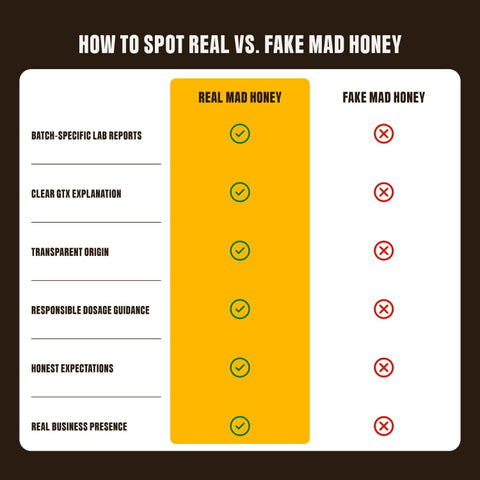
Published batch analysis is what closes that gap. A seller measuring GTX I and GTX III content for each harvest and publishing the figures allows a serving to be judged before it is taken rather than discovered afterwards, and the wider picture of what mad honey contains explains why those figures move so much between batches.
Real Mad Honey publishes independent laboratory analysis for every batch it sells, showing grayanotoxin content for the specific honey on the shelf rather than a single report reused across harvests. Batches falling outside the accepted standards are rejected rather than blended into the next, and every jar ships with conservative serving guidance rather than claims about strength.
Bottom Line: What Too Much Actually Means
Too much mad honey produces an uncomfortable few hours rather than anything more serious for most healthy adults. Dizziness, nausea, sweating and weakness arrive gradually, peak within a couple of hours and settle over the following few, and recovery is generally complete by the next morning.
What helps is mostly a matter of stopping. Lying down, sipping water, eating something light, and waiting covers nearly all of it, while taking more, drinking alcohol, or trying to carry on with the evening extends the discomfort considerably.
Medical attention is worth seeking for persistent vomiting, fainting, chest pain, difficulty breathing, or symptoms that continue worsening after two hours, and sooner for anyone with a heart condition or on blood pressure medication.
The version worth remembering is that this is a dose problem with a known cause and a predictable course. A conservative serving from a tested jar, an hour before reconsidering, and nothing else alongside it makes the whole situation considerably easier to avoid than to manage.