Mad honey is safe at conventional servings for most healthy adults. It is a food rather than a drug; the effects are dose-related and self-limiting, and the vast majority of people who take a teaspoon experience warmth and relaxation rather than anything troubling.
Safety here is a question of quantity rather than of the honey itself, and quantity depends on something most jars never disclose. Grayanotoxin content varies substantially between harvests, which means a sensible serving from one jar is not necessarily a sensible serving from the next, and that variability is the actual safety consideration worth understanding.
Is Mad Honey Safe to Eat?
For healthy adults taking modest amounts, yes. Mad honey has been consumed in Nepal and Turkey for centuries, it is sold legally as a food across most of the world, and problems arise almost exclusively at quantities well beyond what anyone would take deliberately. The reassuring detail in the clinical picture is that adverse reactions are self-limiting. Symptoms from excessive consumption resolve on their own within hours in the great majority of cases; treatment, when needed, is straightforward, and modern fatalities are essentially absent from the medical record despite mad honey being consumed for millennia.
What separates it from ordinary honey is that it contains something active. That is the point of the product, and also the reason serving size matters in a way it does not with a jar from a supermarket shelf.
Anyone treating mad honey as a food to be taken by the spoonful, rather than as a sweetener to be poured freely, is already following the single most important safety principle available.

What Makes Mad Honey Different From Other Honey
The difference is chemical rather than anything visible. Bees foraging on certain rhododendron species collect nectar containing grayanotoxins, and those compounds pass into the honey unchanged during hive processing. Grayanotoxins act on voltage-gated sodium channels, the microscopic gates that let nerve and muscle cells fire electrical signals, holding them open longer than usual. The result is slower signalling across the body, which produces the warmth and physical relaxation people describe at small servings.
That same mechanism explains why quantity matters. The effect scales with dose rather than plateauing, so a larger amount does not simply feel more pleasant but pushes each physiological response further along the same curve, including the effects on heart rate and blood pressure.
Nothing about this is unique to mad honey as a category of food. Plenty of things eaten routinely contain naturally active compounds, and the practical difference is that mad honey's are potent enough to warrant measuring the serving. What mad honey is covers the compounds in more detail.

Why Testing Matters for Safety
This is where mad honey differs from almost every other food in the safety conversation, and it explains why generic dosage advice only goes so far. Grayanotoxin concentration is determined in the field rather than in production. Which rhododendron species dominated the forage, the elevation of the colony, how densely the plants flowered, and the weather across the season all shape what ends up in the honey, and where mad honey comes from explains why those conditions vary so much between harvests.
The consequence is that two jars can differ substantially in potency while looking identical. Colour, thickness and bitterness are shaped by floral source and storage rather than by grayanotoxin content, so nothing observable indicates how strong a particular jar is.
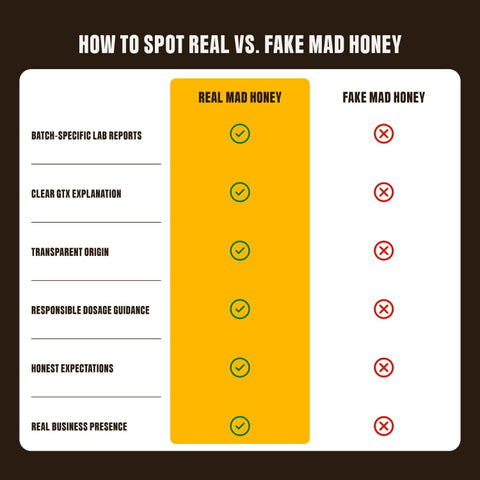
Laboratory analysis is the only thing that closes that gap. A seller measuring GTX I and GTX III content for each batch and publishing the figures allows a serving to be judged before it is taken, while an untested jar means a serving that worked previously is an assumption rather than a plan.
For safety specifically, this matters more than any other single factor. Someone with a tested jar and conservative guidance is working with a known quantity, while someone with an unlabelled jar of unknown origin is not, and that distinction accounts for most of the difference in how people's experiences go.
How Much Mad Honey Is Safe?
A teaspoon is the conventional serving, and starting below that with an unfamiliar jar is sensible rather than overly cautious. The reason for starting low is variability rather than danger. A serving calibrated to one batch may behave differently in another, and the only way to establish how a particular jar behaves is to take a small amount and wait rather than to assume the previous jar is a guide.
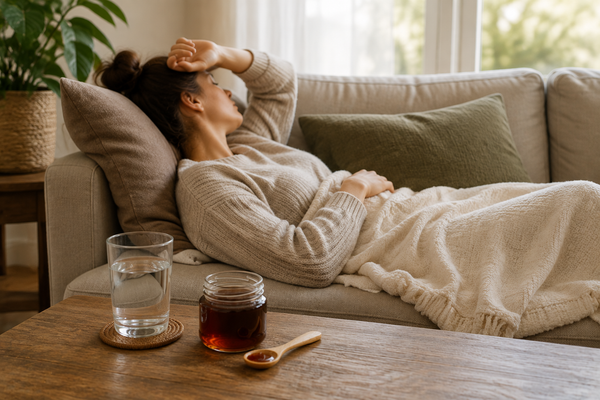
Waiting matters as much as the amount. Effects build over twenty to forty minutes rather than arriving at once, and taking a second serving during that window because nothing seems to be happening accounts for a considerable share of unpleasant experiences.
Frequency is less critical than single-serving size, though moderation applies. Mad honey suits occasional use rather than daily consumption by the spoonful, and treating it as a specialty food taken deliberately rather than as a supplement taken routinely keeps the question straightforward.
What Happens If You Take Too Much
Excessive consumption produces a recognisable set of symptoms, and knowing them makes it easier to distinguish a strong experience from one that needs attention. The common signs are dizziness, nausea, sweating, weakness and lightheadedness, accompanied by low blood pressure and a slowed heart rate. These are the same mechanisms that produce the pleasant effects at smaller quantities, taken further than intended.
The picture is genuinely reassuring in one respect. Symptoms typically resolve within a few hours without intervention; treatment where required is straightforward and effective, and serious outcomes are rare in the modern medical record.
Most cases involve either a large amount taken at once, a second serving taken before the first had taken effect, or mad honey combined with alcohol. All three are avoidable, and all three are considerably more common than any problem arising from a conventional serving.
Anyone experiencing pronounced dizziness, vomiting, fainting, or a heart rate that feels unusually slow should seek medical attention, and should say what was taken and how much, since that makes assessment straightforward.
Who Should Avoid Mad Honey
Several groups should not take mad honey, or should speak to a doctor before doing so, and the reasons are specific rather than precautionary, since each has a clear mechanism behind it:
-
Anyone with a heart condition. The effects on heart rate and blood pressure are the mechanism rather than a side effect, which makes existing cardiac conditions a genuine contraindication.
-
Anyone with low blood pressure. Mad honey lowers it further, so a starting point already on the low side is a reason to avoid it.
-
Anyone taking blood pressure medication. The effects compound, and beta blockers in particular warrant medical advice first.
-
Anyone pregnant or breastfeeding. There is no research establishing safety in either case, which is reason enough.
-
Children. Mad honey is an adult product, and honey generally is not given to infants under twelve months.
-
Anyone combining it with alcohol or sedatives. Both affect blood pressure and coordination, and the combination accounts for most difficult experiences.
Anyone taking regular medication of any kind, or managing a diagnosed condition, should raise it with a doctor rather than assume a natural product carries no interaction.
How to Take Mad Honey Safely
Most of what makes mad honey safe is straightforward, and none of it requires equipment or expertise. Five habits cover nearly all of it.
Start Below a Teaspoon
Any new jar warrants a smaller serving than the last one, since batches differ in potency and a familiar amount is a guess rather than a guide until that particular honey has been tried.
Wait a Full Hour
Effects build over twenty to forty minutes rather than arriving at once. Taking a second serving during that window because nothing seems to be happening accounts for the majority of unpleasant experiences, and waiting costs nothing.
Avoid Alcohol Alongside It
Both affect blood pressure and coordination, and the combination compounds each. This is the single most common factor in difficult experiences after serving size, and it is entirely avoidable.
Stay Seated for the First Twenty Minutes
Blood pressure runs lower during the effects, so standing up quickly can cause lightheadedness. There is no advantage to standing while the effect builds, and sitting through the onset removes the most likely source of discomfort.
Store It Simply
A sealed jar kept at room temperature away from direct sunlight holds its character for years, and a clean, dry spoon each time keeps moisture out. Crystallisation is normal in raw honey and indicates neither spoilage nor reduced potency.
Every habit above assumes a known quantity, which is why buying from a seller publishing batch figures underpins the rest rather than sitting alongside them.

Buying Tested Mad Honey
Testing is the difference between guidance that applies and guidance that is guesswork, which makes the seller a safety decision rather than only a commercial one. Real Mad Honey publishes independent laboratory analysis for every batch it sells, showing GTX I and GTX III content for the specific honey on the shelf rather than a single report reused across harvests. Batches falling outside the accepted standards are rejected rather than blended into the next.
The honey is wild-harvested in the Himalayas through established Nepalese honey-hunting communities, with the harvesting region stated rather than described in general terms, and every jar ships with conservative serving guidance rather than claims about intensity.
Jars run from 50g to 500g, prices include tax, and a 60-day policy covers sealed returns and money-back requests.
The Bottom Line on Mad Honey Safety
Mad honey is safe for most healthy adults taking conventional servings, and the evidence for that is stronger than its reputation suggests. Adverse effects are dose-related, self-limiting, and resolve within hours; treatment where needed is effective, and centuries of traditional use have not produced the pattern of serious harm that the more dramatic accounts imply.
The risk that does exist is concentrated in two places. The first is quantity, since almost every difficult experience involves a large serving, a second serving taken too early, or a combination with alcohol, and all three are entirely within a person's control. The second is potency, since a jar of unknown strength makes any serving a guess regardless of how carefully it is measured.
Take the specific exclusions seriously rather than treating them as a general disclaimer. Heart conditions, low blood pressure, blood pressure medication and pregnancy are genuine contraindications with clear mechanisms behind them, and none of them is a case for proceeding cautiously rather than seeking advice.
For everyone else, the practical position is simple. A tested jar, a serving below a teaspoon, a full hour before reconsidering, and no alcohol alongside covers nearly all of it, and that combination turns mad honey from an unknown into a food with a known active compound taken in a known amount.