If you have come across it through a documentary, a podcast or a friend who brought a jar back from Nepal, you may be wondering what actually makes it different and how to tell a genuine jar from an ordinary one. Where it comes from, how it is made and how to spot a genuine jar are covered below.
What is mad honey?
Mad honey is honey containing grayanotoxins, compounds found naturally in the nectar of certain rhododendron species that pass into the honey unchanged.
The grayanotoxins are not produced by the bees or added afterwards. They exist in the rhododendron nectar before a bee arrives at the flower, and the honey carries them through unchanged, which is why a jar reflects a particular hillside in a particular season.
It goes by several names depending on where it comes from and who is selling it:
-
Himalayan mad honey
-
Nepalese mad honey
-
Red honey
-
Cliff honey
-
Deli bal, the Turkish name
The concentration varies considerably from one harvest to another, which is why two jars can look identical and behave quite differently. You can read more about what mad honey is and where its compounds come from.
Where does mad honey come from?
Mad honey comes from a small number of high-altitude regions where grayanotoxin-bearing rhododendrons grow densely enough to dominate what bees collect, principally the Himalayan belt through Nepal.
The Nepalese harvest takes place in the mountain districts of the country's central belt, with Lamjung, Myagdi and the wider Annapurna region among the areas most associated with it. Colonies build on exposed cliff faces at elevations above 2,500 metres, in terrain that no road reaches.
Density is what limits the map. Grayanotoxin-bearing plants grow more widely than that, including elsewhere in the Himalayas and in parts of North America and East Asia, but scattered plants in a mixed landscape produce honey with only traces of the compounds and no noticeable effect.
Altitude does the rest. Above 3,000 metres the plant community thins out sharply, so rhododendrons make up a far greater share of what a foraging colony can reach than they would lower down. Where mad honey comes from covers the harvesting regions in more detail.
How is mad honey made?
Mad honey is made the same way any honey is made, by bees converting flower nectar inside the comb. The difference is entirely in the flower.
The process runs as follows:
-
Bees forage on rhododendron flowers whose nectar contains grayanotoxins.
-
The nectar is carried back to the comb and passed between workers, whose enzymes break down the complex sugars.
-
The colony fans the comb to reduce the water content until the honey will keep.
-
The cells are capped with wax, and the grayanotoxins remain unchanged throughout.
Harvesting is where mad honey diverges from everything else. In Nepal, it is collected from wild colonies on vertical cliff faces by teams working with bamboo ladders and ropes, during a few weeks each spring when the rhododendrons flower.
Nothing is added at any stage. There is no formulation, no standardisation and no way to make a weak harvest stronger, which is why the honey arrives in a jar as a record of one season on one hillside.
What makes mad honey different from regular honey?
The difference is chemical rather than anything you can see. Mad honey contains grayanotoxins and ordinary honey does not.
Beyond that, several practical differences follow:
-
How it is taken. Mad honey is eaten by the teaspoon rather than used as a sweetener.
-
What it does. It produces warmth, physical relaxation, and a slower mental pace rather than simply tasting sweet.
-
How it is harvested. Wild cliff colonies rather than managed hives on accessible ground.
-
How much exists. A few weeks of flowering each year rather than a continuous supply.
-
How it varies. Potency differs between harvests, so consistency is not expected.
-
What it costs. Considerably more per gram than any supermarket honey.
Taste differs too. Mad honey runs darker and thicker than most honey, with an earthy, resinous character and a distinct bitterness on the finish, alongside a slight catch at the back of the throat shortly after swallowing.
How can you tell if mad honey is real?
You cannot tell by looking, which is the most important thing to know before buying. Colour, thickness, bitterness and price are all shaped by things other than grayanotoxin content.
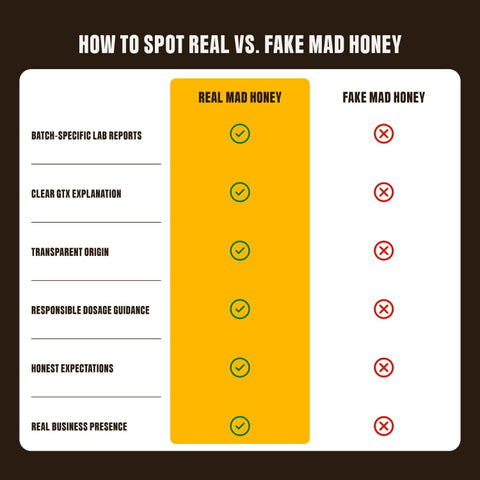
What establishes it is laboratory analysis. A seller measuring GTX I and GTX III content for each batch and publishing the figures is telling you what is in the jar, while a seller describing the honey in general terms is asking you to take it on trust.
The signals worth checking are:
-
Published testing tied to the batch on sale, not a single old report
-
A named harvesting region rather than vague terms like Himalayan or wild
-
Conservative serving guidance rather than claims about extreme strength
-
Honest acknowledgement that harvests differ from one another
-
Clear contact details, return terms and customer service
Analyses of samples sold as mad honey have found grayanotoxin absent altogether in a substantial proportion of them, which is why the report matters more than any description of the honey.
Where to buy mad honey?
Mad honey is sold almost entirely through specialist online retailers, since it rarely appears in supermarkets or general health shops.
Buying from a seller holding domestic stock is the simplest route. Delivery runs on ordinary timescales, prices include tax, and returns follow local consumer rules rather than an international process.
Real Mad Honey publishes independent laboratory analysis for every batch it sells, showing grayanotoxin content for the specific honey on the shelf. The honey is wild-harvested in the Himalayas through established Nepalese honey-hunting communities, and batches falling outside the accepted standards are rejected rather than blended into the next one.
Jars run from 50g to 500g, prices include tax, and a 60-day policy covers sealed returns.
Choosing genuine mad honey
The right jar is the one you know something about, which in this category means one with figures behind it rather than a description.
If you are buying for the first time, start with a smaller jar. It costs less than committing to a larger one and lets you find out how a particular batch behaves before buying in quantity.
If you already know you like it, larger jars bring the cost per serving down considerably and mean one batch lasts across months rather than changing with each purchase.
Either way, check the batch report before the label. Explore the full range of tested mad honey to see what is currently available.