If you are trying to work out what makes the Nepalese version distinctive, or how it differs from other honey sold under the same name, the answers lie in the bees, the flowers and the way it is collected.
What is Nepalese mad honey?
Nepalese mad honey is honey produced by wild Himalayan bee colonies foraging on rhododendron species whose nectar contains grayanotoxins.
Three things distinguish it from other honey, including from mad honey produced elsewhere:
-
It comes from wild colonies rather than managed hives
-
The bee is the largest honey bee species in the world
-
Every jar is collected by hand from a cliff face
The honey itself runs darker and thicker than most, with an earthy character and a distinct bitterness, and it is generally regarded as the stronger of the mad honeys available. You can read more about what mad honey is and the compounds behind its effects.
Where in Nepal does mad honey come from?
Nepalese mad honey comes from the mountain districts of the country's central belt, with Lamjung, Myagdi, Kaski and the wider Annapurna region among the areas most associated with it.
Colonies sit at elevations between roughly 2,500 and 3,500 metres, and the bees forage higher still, up to around 4,100 metres. The terrain is reachable only on foot, which is one reason the harvest has never been mechanised.
Altitude is what makes these places productive:
-
Above 3,000 metres, the plant community thins out considerably.
-
Rhododendrons make up a far greater share of the available forage.
-
Bees collect disproportionately from them during the flowering window.
-
The resulting honey carries a much higher grayanotoxin concentration than honey from lower ground.
The same rhododendrons growing in a mixed lowland forest would produce honey with only traces of the compounds. The harvesting tradition behind these cliffs has passed through the same families for generations.
What bees make Nepalese mad honey?
Nepalese mad honey is made by Apis laboriosa, the Himalayan giant honey bee and the largest bee species in the world.
Workers reach close to three centimetres in length, nearly twice the size of the European honey bee that produces almost all commercial honey. The species builds single enormous combs in the open air beneath cliff overhangs, usually on rock faces catching the afternoon sun.
The decisive fact about it is that it cannot be kept. Every attempt to move these colonies into conventional hives has failed, since the species did not evolve to nest in enclosed spaces and abandons any structure it is placed in.
That is why there is no farmed version of Nepalese mad honey and never has been. Every jar traces back to a wild colony that chose its own cliff, which is also why the supply is limited by geography rather than by demand.
How is mad honey harvested in Nepal?
Mad honey is harvested by teams of ten to fifteen people working a single cliff, during the flowering window in April and May, with a smaller collection sometimes following in autumn.
The process has barely changed in generations:
-
Ladders are woven from bamboo and rope and dropped from the clifftop.
-
Smoke is raised from the base of the cliff to move the bees off the comb.
-
One or two harvesters descend to the nest while the rest manage the lines from above.
-
Sections of comb are cut free with long poles.
-
The comb is lowered in woven baskets to collectors waiting below.
Nests commonly sit twenty-five metres or more above the valley floor, and a single cliff can occupy a full day. The work is dangerous, and in many communities it carries ceremonial weight alongside its practical purpose.
Nothing about it scales. The number of accessible cliffs is fixed, the flowering window lasts a few weeks, and the number of people able to do the work is falling as younger generations move toward cities.
What does Nepalese mad honey taste like?
Nepalese mad honey tastes considerably stronger than ordinary honey, with an earthy, resinous character and a bitterness that arrives on the finish.
The usual sequence is:
-
First: sweetness, though less pronounced than in supermarket honey
-
Then: an earthy, slightly floral depth
-
After: a distinct bitterness building at the back of the palate
-
Finally: a mild catch or tingling in the throat, arriving a minute or two later
It runs deep amber to reddish brown in colour and is noticeably thicker than most honey, and it crystallises readily as it sits, which is normal in raw honey and indicates neither age nor a problem.
Taste varies between harvests, since the flowers, the altitude and the season all shape it. That variation is a feature of a wild product rather than an inconsistency, and appearance is a poor guide to strength in either direction.
Where to buy Nepalese mad honey?
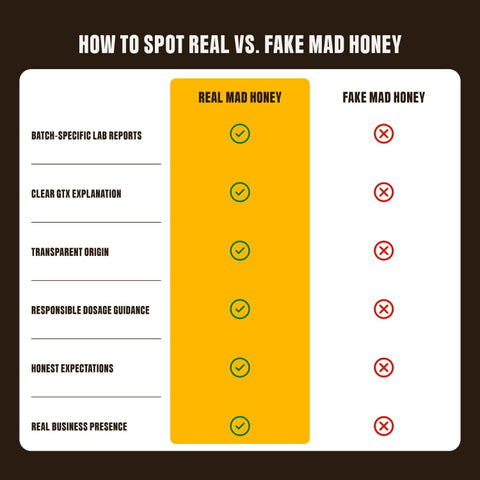
Nepalese mad honey is sold almost entirely through specialist online retailers, and what separates them is what they can tell you about the jar.
Worth checking before buying:
-
Published laboratory analysis tied to the batch on sale
-
A named harvesting region rather than vague terms like Himalayan
-
Conservative serving guidance rather than claims about strength
-
Honest acknowledgement that harvests differ
-
Clear contact details and return terms
Real Mad Honey sources through established Nepalese honey-hunting communities and publishes independent laboratory analysis for every batch it sells, showing grayanotoxin content for the specific honey on the shelf.
Any harvest that does not meet the standard is turned down rather than mixed into the next batch to bring the average up. Sizes start at 50g for a first purchase and run to 500g, with tax included in the price and sealed jars returnable within 60 days.
Choosing a Nepalese mad honey
The jar worth buying is the one with figures behind it, since nothing about the honey's appearance tells you how strong it is.
For a first purchase, a smaller jar makes sense. A 50g jar is the sensible way in. It holds around ten servings, which is enough to learn how a particular harvest behaves before deciding whether to buy more of it.
Anyone already familiar with the category tends to move to the larger sizes, where the cost per serving drops considerably, and a single harvest carries through several months rather than changing with every order.
Either way, read the batch report before the description. Explore the current Nepalese harvests to see what is available now.