- Mad honey doesn't get you high in the way most people imagine.
- In small amounts, people commonly report relaxation, warmth, and a mellow, slightly light-headed mood.
- Taking more doesn't bring a bigger high, only unpleasant symptoms.
- How mad honey feels varies with the batch, the amount, and the person.
Search for mad honey online, and you'll find it described as a "psychedelic honey", a "natural high", or even a hallucinogen from the Himalayas. Some of those stories are told for clicks, and some come from people who took far too much. So what is the mad honey high really like, and does mad honey get you high at all?
The short answer is that most people who try it describe something much gentler than the headlines suggest. This guide separates what people actually report from the hype, compares the feeling with substances many already know, and explains why chasing a stronger "high" is the wrong way to approach it.
Does Mad Honey Get You High?
Not in the way most people mean by "high". Mad honey contains naturally occurring grayanotoxins from rhododendron nectar. In small amounts, people commonly report feeling relaxed, warm, and pleasantly mellow, sometimes with a light-headed or slightly floaty sensation. At the amounts people normally take, it doesn't cause visual changes or a loss of touch with reality. Most people say their thinking stays fairly clear. It's closer to a calm, heavy-bodied relaxation than to being drunk, stoned, or tripping.
What People Mean When They Say "Mad Honey High"
The phrase "mad honey high" has spread mainly through travel stories, documentaries, and social media. Many of these stories focus on the honey hunters of Nepal climbing rope ladders to reach cliff nests and then on the honey's reputation for making people feel strange. Over time, "feel something" has turned into "get high", and that's where expectations start to drift from reality.

The word "high" means very different things to different people. For some, it's the loosened, chatty feeling after a couple of drinks. For others, it's the effect of cannabis or the altered senses of a psychedelic. Mad honey doesn't match any of these, which is why people who expect a strong high are often surprised.
Part of the confusion also comes from stories about people who ate large amounts and became unwell. Those accounts describe a very different experience, one that has more in common with feeling ill than with any kind of high. When those stories are mixed in with descriptions of the gentle effects of a small amount, the picture gets muddled.
The honest version sits somewhere in between. Mad honey can change how you feel, which is a big part of its appeal. But the change most people describe is subtle and body-focused, not a dramatic shift in perception.
How the Mad Honey Feeling Compares to Other "Highs"
The easiest way to understand the mad honey feeling is to compare it with substances people already know. Most people have a sense of what a couple of drinks feel like or have at least heard friends describe cannabis or psychedelics, so these make useful reference points. The descriptions below are general, and individual experiences vary a lot, especially with the amount taken.
| Mad honey (small amount) | Alcohol | Cannabis | Psychedelics | |
|---|---|---|---|---|
| Mood | Relaxed and mellow | Loosened and chatty | Relaxed or giggly, sometimes anxious | Intense and unpredictable |
| Body | Warm, heavy, a little light-headed | Warm and unsteady | Heavy and slowed down | Varies widely |
| Thinking | Mostly clear | Judgement impaired | Distracted and slower | Strongly altered |
| Perception | Unchanged | Unchanged | Mildly altered | Visual and sensory changes |
| Legal status in the UK | Sold as a food | Legal for adults | Controlled drug | Controlled drugs |
Mad Honey High Myths vs Reality
A lot of what's written about mad honey mixes real reports with exaggeration. These are the claims we see most often, and what's actually true.
Myth: Mad honey is a psychedelic
The reality: At the small amounts people normally take, mad honey doesn't cause visual effects, distorted senses, or the kind of altered state people associate with psychedelics. Grayanotoxins work quite differently from psychedelic substances, and the effects people describe are mostly physical: warmth, heaviness, and relaxation. Calling mad honey a psychedelic makes for a better headline, but it doesn't match what most people experience.
Myth: Nepali mad honey is a hallucinogen
The reality: Hallucinations have been reported in some accounts of people who ate very large amounts of mad honey, but those same accounts usually describe serious symptoms like vomiting, a very slow heartbeat, and fainting. In other words, they describe poisoning, not a pleasant trip. At normal amounts, Nepali mad honey is not a hallucinogen, and anyone who takes a large amount hoping for visuals is far more likely to end up feeling very ill.
Myth: The more you take, the better it feels
The reality: This is the most important myth to get right. With mad honey, more doesn't mean a stronger version of the same pleasant feeling. Past a certain point, the relaxation gives way to nausea, dizziness, sweating, low blood pressure, and a slow heart rate. People who chase a bigger effect usually end up feeling much worse.
Myth: Mad honey works like an edible
The reality: Some people compare the heavy, relaxed body feeling to a mild cannabis edible, and that comparison makes sense to a point. But mad honey contains no THC, and it doesn't produce the giggly, distracted, or time-stretching effects many people associate with edibles. The similarity is mostly in the body, not the mind.
Myth: The effects are just placebo
The reality: The opposite claim to the hype is that mad honey does nothing, and people only feel what they expect to feel. Expectation can play a part in any experience, but mad honey's effects come from a real, measurable group of compounds. Grayanotoxins can be detected and measured in a lab, and their effects on the body are documented in medical literature, including in cases where people took too much. So while the gentle effects of a small amount are easy to overstate, they aren't imaginary either.
Myth: Mad honey is only for thrill-seekers
The reality: Plenty of people buy mad honey for reasons that have nothing to do with chasing a feeling. Some are drawn by its dark, earthy, slightly bitter taste, which stands out next to everyday honey. Others are interested in its story, from the Himalayan giant honey bees that nest on cliff faces to the honey hunters who harvest it by hand. For many people, trying a small amount is more about curiosity than about getting high.
Myth: Every jar feels the same
The reality: Mad honey is a raw, wild product, and the amount of grayanotoxin varies from one harvest to the next. Two jars from different batches can feel noticeably different, even at the same amount. That's why it's worth checking the lab report for your batch, which shows its grayanotoxin content, and starting small with every new jar.
Myth: Darker or more bitter honey is stronger
The reality: Colour and taste come mainly from the flowers the bees visit, the season, and the region. A darker or more bitter jar doesn't necessarily contain more grayanotoxin than a lighter one. The only reliable way to know is a lab test.
Myth: If you feel nothing, it's fake
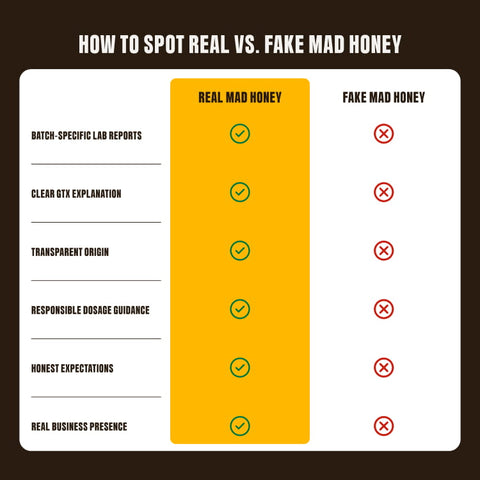
The reality: Some people feel very little from a small amount, especially the first time, if they've eaten a large meal beforehand or if the batch contains less grayanotoxin. Feeling nothing doesn't automatically mean the honey is fake. That said, real mad honey should come with clear information about its origin and testing to distinguish real vs fake mad honey.
Myth: Mad honey is an illegal drug in the UK
The reality: Mad honey is sold in the UK as a food product, not as a controlled drug. That doesn't mean it's suitable for everyone, and it should be treated with the same care as anything that affects how you feel.
Why Mad Honey Feels Different From Person to Person
Even with the same jar, two people can have quite different experiences. A few things make the biggest difference.
- The batch: Grayanotoxin levels change with the season, the altitude, and the mix of flowers the bees visited. A batch from one harvest can feel noticeably different from the next, which is why lab reports matter.
- The amount: Small differences in how much you take can change how strongly you feel the effects. A rounded spoon is not the same as a level one, so measure carefully.
- Food in your stomach: People commonly report that mad honey feels gentler and slower to start on a full stomach and more noticeable on an empty one.
- Your body: Body weight, general health, and individual sensitivity all play a part. Some people are simply more sensitive to grayanotoxins than others.
- What else you've taken: Alcohol and some medications can change how mad honey affects you, and not in a good way. Mixing it with alcohol is a common reason people end up feeling unwell.
- Your setting and expectations: How you feel about the experience matters too. Someone who tries a small amount at home on a quiet evening, expecting gentle relaxation, often finds it pleasant. Someone who expects a dramatic high may spend the evening waiting for something that never comes or be tempted to take more, which is where problems start.
Because of all this, it's hard to predict exactly how mad honey will feel for you, even from someone else's description. That's one more reason to treat stories about "the mad honey high" with some caution.
Why Chasing a Mad Honey High Is a Bad Idea
If you go into mad honey hoping for a strong high, you're more likely to take too much, and that's when things go wrong. The pleasant effects people describe happen at small amounts. Larger amounts don't intensify them. Instead, they bring dizziness, nausea, vomiting, cold sweats, low blood pressure, and a slow heart rate, and in serious cases, people need hospital treatment.
Mad honey also isn't suitable for everyone. Don't take it if you:
- have a heart condition or low blood pressure
- take medication that affects your heart rate, blood pressure, or nervous system
- are pregnant or breastfeeding
- are under 18
If you have any other health condition or take regular medication, talk to your doctor before trying it.
If you feel unwell after taking mad honey, call NHS 111 for advice. If symptoms are severe, such as fainting, chest pain, or a very slow heartbeat, call an ambulance and tell them what you've taken and how much.
How to Set Realistic Expectations Before You Try Mad Honey
The best way to enjoy mad honey is to expect something subtle. Think of it as a gentle change in how your body feels, not an event. A few simple habits help:
- Start small: Follow our dosage guidance, and don't take more because you don't feel much at first.
- Clear your schedule: Try it at home on a day when you don't need to drive, work, or look after anyone.
- Skip the alcohol: Don't mix mad honey with drinks.
- Give it time: Effects can take a while to appear, and everyone's timeline is different, so wait before deciding whether you feel anything.
- Check the batch: Look up the lab report before you open a new jar.
Approached like this, mad honey is less about getting high and more about an unusual, relaxing experience with a long history behind it. It also helps to keep notes on your first try: the batch, the amount, whether you'd eaten, and how you felt. That way, if you try it again, you're working from your own experience instead of someone else's story.
Final Thoughts
The mad honey high is real in the sense that mad honey can change how you feel. But for most people, at the small amounts they normally take, that change is a calm, warm, slightly light-headed relaxation, not a psychedelic trip or a drunken buzz. The hype comes from dramatic headlines, mixed-up stories, and accounts of people who took far too much. Treat mad honey as something to try carefully, start small, and leave the idea of a "high" at the door.