- The first written account of mad honey comes from the Greek writer Xenophon, who described its effect on an army in 401 BC.
- In 67 BC, tribes on the Black Sea coast reportedly used mad honey to ambush Pompey's Roman soldiers.
- In Nepal, mad honey has been harvested from cliff nests for generations as part of a honey-hunting tradition.
- Today, mad honey is harvested on a small scale, tested in laboratories batch by batch, and sold around the world.
Few foods have a history as unusual as mad honey’s. It turns up in ancient Greek war writing, in Roman military history, and in ancient natural history books, usually because of what happened to the people who ate it. Far from the Mediterranean, it’s also part of a harvesting tradition in the Himalayas that has been handed down for generations.
This article traces that history, from a retreating Greek army in 401 BC to the lab-tested jars on sale today.
What Is the History of Mad Honey?
Mad honey has been written about for around 2,400 years. The Greek writer Xenophon described it in 401 BC, after his soldiers ate wild honey near the Black Sea. Roman soldiers were reportedly ambushed with it in 67 BC. In Nepal, honey hunters have harvested it from Himalayan cliff nests for generations. In the 20th century, scientists traced its character to grayanotoxins in rhododendron nectar.
Mad Honey in the Ancient World
The earliest stories of mad honey come from the ancient Black Sea coast, a region the Greeks and Romans knew as Pontus. They come to us through soldiers and the historians who wrote about them.
Xenophon and the Ten Thousand (401 BC)
In 401 BC, around 10,000 Greek mercenaries found themselves stranded in Persian territory after a failed campaign. Xenophon, one of their commanders, later wrote about their long retreat north to the Black Sea.
Near the coast, the soldiers came across beehives and ate the honey. According to Xenophon, many of them soon couldn’t stand, and some behaved as if they were drunk. By the following day the men began to recover, and within a few days they were able to march on. It's the oldest known written account of mad honey.
How Mad Honey Was Used Against Pompey's Army (67 BC)
Mad honey's second famous appearance was less accidental. In 67 BC, the Roman general Pompey was campaigning in the region against Mithridates VI, king of Pontus.
According to the Greek geographer Strabo, a local tribe left honeycombs along the route of Roman troops passing through the mountains. The soldiers ate them, became disoriented and sick, and were then attacked.
What Ancient Writers Said About Mad Honey
Mad honey also appeared in the scientific and medical writing of the ancient world. Aristotle mentioned honey from the Black Sea region with unusual properties. In the first century AD, the Roman writer Pliny the Elder described a "mad honey" in his Natural History and linked it to the plants the bees fed on. The Greek physician Dioscorides wrote about it around the same time.
None of these writers could explain what made the honey different. But several of them pointed in the right direction: towards the flowers.
Mad Honey in Nepal's Himalayan Tradition
Thousands of kilometres away, in the Himalayan foothills of Nepal, mad honey has a history of its own, one passed down through families rather than written in books.
There, the Himalayan giant honey bee, Apis laboriosa, builds its nests on sheer cliff faces and feeds on the nectar of wild rhododendrons. For generations, communities such as the Gurung in central Nepal and the Kulung in the east have harvested this honey by hand, climbing rope ladders made from bamboo and plant fibre to reach the combs.
Honey hunting has been seen as more than a job. Before a harvest, hunters traditionally make offerings and say prayers to the spirits believed to guard the cliffs. The skills, routes, and knowledge of which cliffs to visit are passed down within families. Mad honey was valued locally, too, and kept for special use rather than eaten every day.

How Science Explained Mad Honey
For centuries, people knew that some types of honey were different without knowing why. The ancient writers' guesses about the flowers turned out to be right.
Mad honey's character and effects come from grayanotoxins, a group of natural compounds found in the nectar of certain rhododendron species. When bees feed heavily on that nectar, the compounds pass into the honey. Scientists identified and studied grayanotoxins in the 20th century, explaining accounts that had been around since Xenophon.
This also explains why mad honey varies so much. The amount of grayanotoxin depends on which rhododendrons the bees visit, where they grow, and the season, so no two harvests are exactly alike. Chances are that if you bought more than one jar of mad honey, you’ve seen the variety for yourself.
Mad Honey Today: From Cliff Nests to Modern Jars
Mad honey is still harvested in much the same way as it has been for generations: by hand, on a small scale, and only in certain seasons. What has changed is what happens after the harvest.
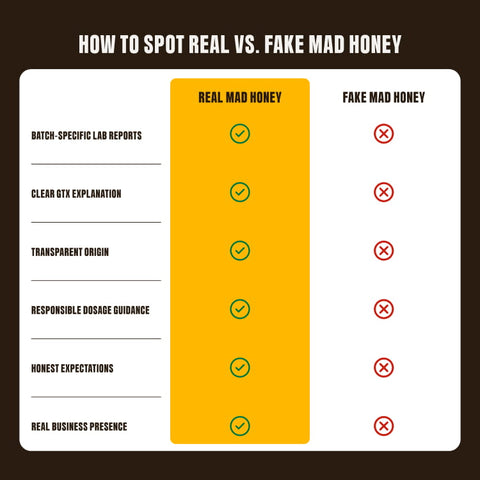
Because grayanotoxin content varies from batch to batch, reputable sellers now send each batch to an independent laboratory for testing. At Real Mad Honey, you can look up the report that applies to your order on our lab report page. Online shops have also made mad honey available far beyond the Himalayas.
Mad honey isn't for everyone, though. If you have a heart condition or low blood pressure, take regular medication, or are pregnant or breastfeeding, talk to your doctor before trying it.
Final Thoughts
Mad honey’s history runs from the ancient Black Sea coast, where Xenophon’s soldiers stumbled on it in 401 BC, and Pompey’s troops were ambushed with it in 67 BC, to the Himalayan cliffs of Nepal, where honey hunters have harvested it for generations.
Ancient writers suspected the flowers were behind it, and modern science confirmed that grayanotoxins in rhododendron nectar give the honey its character. Much of the harvest still looks the way it always has. The biggest change is that buyers can now check a batch’s grayanotoxin content before they try it.