- Manuka honey is graded on industry scales, mainly UMF and MGO, putting a number on the label of almost every jar.
- Mad honey comes from rhododendron nectar in Nepal and has no grading scale.
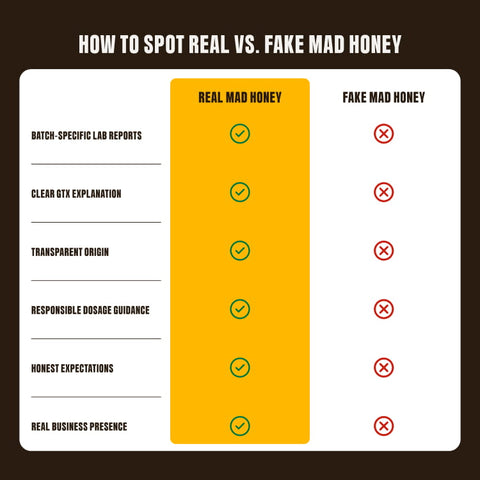
- Reputable mad honey sellers have each batch tested in a laboratory for its grayanotoxin content.
- A higher manuka grade is treated as more desirable and priced accordingly. A mad honey lab result simply describes a batch; it isn't a quality score.
- Mad honey isn't suitable for everyone, so talk to your doctor before trying it if you have a heart condition or low blood pressure, or take regular medication.
If you’ve bought manuka honey in the UK, you’ve seen the number on the label: UMF 10+, MGO 263+, or something similar. That number is a grade, and it’s a big part of what you’re paying for.
Mad honey has no grade. There’s no industry scale and no number on the front of the jar. What a good seller offers instead is a lab report for each batch, showing how much grayanotoxin the honey contains. This guide explains how both systems work, what the figures measure, and what they mean when you’re deciding what to buy.
What's the Difference Between Mad Honey and Manuka Honey?
Manuka honey comes from the manuka bush in New Zealand and is graded on standard industry scales, mainly UMF and MGO.
Mad honey comes from rhododendron nectar in Nepal and has no grading scale. Instead, each batch is tested in a laboratory for its grayanotoxin content, and the results are published as a lab report.
Manuka Honey
Manuka honey is made by honeybees that feed on the flowers of Leptospermum scoparium, a shrub native to New Zealand and parts of southeastern Australia. Beekeepers place hives near stands of manuka during its short flowering season, often in remote hill country.
It's thick, dark cream to amber and has a rich, slightly herbal taste that's noticeably different from everyday flower honey. It also contains unusually high levels of methylglyoxal (MGO), the compound manuka is best known for. Because production is limited and demand is high, a whole grading system has grown up around it.
Mad Honey
Mad honey comes from the Himalayan foothills of Nepal. It's made by Apis laboriosa, the Himalayan giant honeybee, which builds its nests on open cliff faces and feeds on rhododendron nectar. Honey hunters harvest it by hand, using rope ladders to reach the nests.

It's darker than manuka, with an earthy flavour and a noticeably bitter finish. The rhododendron nectar gives it naturally occurring grayanotoxins, which many people associate with its calm, mellow feel.
Buying mad honey needs a little more consideration than manuka. It isn't suitable for people with heart conditions or low blood pressure, anyone taking medication that affects their blood pressure, heart rate, or nervous system, people who are pregnant or breastfeeding, or anyone under 18. If any of these apply to you, or you're unsure, talk to your doctor before trying it.
How Manuka Honey Is Graded
Manuka's grading systems exist to answer two questions: is this genuine manuka, and how much MGO does it contain? You’ll likely see two scales:
MGO (Methylglyoxal)
MGO stands for methylglyoxal, the natural compound manuka honey is best known for. An MGO rating tells you how much methylglyoxal was measured in the honey, in milligrams per kilogram. A jar labelled MGO 263+ contains at least 263 mg of methylglyoxal per kilogram of honey.
MGO is a direct measurement, which makes it easy to understand. On its own, though, it doesn't confirm that the honey is genuine manuka, only how much methylglyoxal it contains.
UMF (Unique Manuka Factor)
UMF is a grading system run by the UMF Honey Association, an industry body in New Zealand. A UMF grade, such as UMF 10+ or UMF 20+, is based on multiple natural markers measured together, including methylglyoxal and leptosperin, a compound found in manuka nectar that helps confirm authenticity.
Only licensed producers can use the UMF mark, and each batch must be tested before it can carry a grade. That makes UMF a broader check than MGO alone, covering both authenticity and strength.
How the Two Scales Line Up
Because UMF includes methylglyoxal, the two systems can be roughly matched:
| UMF grade | Approximate MGO |
|---|---|
| UMF 5+ | MGO 83+ |
| UMF 10+ | MGO 263+ |
| UMF 15+ | MGO 514+ |
| UMF 20+ | MGO 829+ |
How to Read a Label on Manuka Honey
The grade usually appears prominently on the front of the jar. Check three things before picking a jar:
- The scale name: A number on its own, like "15+", means little unless the label says which scale it refers to.
- The UMF mark and licence number: Genuine UMF honey carries the official mark and a producer licence number.
- Packed in New Zealand: Most graded manuka is packed at the source before export.
How Mad Honey Is Tested
Mad honey takes a completely different approach. There's no scale, so the information comes from testing each batch in a lab.
Batch Testing for Grayanotoxins
Each batch of mad honey should be sent to an independent laboratory to measure its grayanotoxin content. Lab reports for mad honey usually focus on GTX I and GTX III, the two grayanotoxins most often measured in honey, and give a value for each.
At Real Mad Honey, batches are tested by an independent laboratory, and you can look up the report that applies to your order on our lab report page.
Why There's No Grading Scale
Manuka has grading scales because a large, organised industry agreed on them. Mad honey is produced on a smaller scale, mostly by honey hunters in Nepal, and there's no equivalent body setting a standard.
There's also a practical reason. Grayanotoxin content changes naturally from harvest to harvest, depending on the rhododendron species the bees visit, the altitude, and the season. A fixed grade wouldn't capture that variation, but a lab report for each batch does.
What a Mad Honey Lab Report Shows
A proper lab report names the laboratory, the test date, the honey it applies to, and the measured values for each grayanotoxin, with units. It's a description of what's in that particular batch, not a rating.
If you're comparing mad honey brands, a full, batch-specific report is one of the clearest signs you're looking at genuine mad honey.
Grading vs Testing: Side by Side
Here’s how the two systems compare.
| Manuka honey | Mad honey | |
|---|---|---|
| What's measured | Methylglyoxal (MGO), plus authenticity markers for UMF | Grayanotoxins, usually GTX I and GTX III |
| Who sets the standard | Industry bodies, such as the UMF Honey Association | No industry standard; batch testing by independent labs |
| What it looks like | A grade on the front label, such as UMF 15+ or MGO 514+ | A lab report, usually published online by the seller |
| What a higher number means | A higher grade, usually at a higher price | More grayanotoxin in that batch, not a "better" honey |
| Batch-specific | Tested per batch before grading | Tested per batch, with results for each one |
What the Numbers Mean When You Buy
With manuka, the number on the jar is a selling point. Higher UMF and MGO grades are treated as more desirable, and prices rise steeply as the grade increases. Choosing manuka often comes down to deciding which grade you want to pay for.
With mad honey, the numbers work differently. A higher grayanotoxin value doesn't make one batch "better" than another; it simply describes what's in it. What matters more is that the report exists, that it's recent, and that it applies to the honey you're buying.
Mad Honey or Manuka: Which Should You Buy?
Manuka and mad honey aren't really rivals. They're bought for different reasons and used in different ways.
Manuka is a premium honey that many people keep in the cupboard for toast, tea, and porridge, choosing a grade that suits their budget.
Mad honey is something people reach for in the evening, in small amounts, for its calm, mellow feel. If you want a rich honey to use every day, manuka fits. If you're curious about a traditional Himalayan honey with a very different character, mad honey might be the one for you.
Final Thoughts
Manuka and mad honey both come with numbers, but they mean very different things. Manuka's UMF and MGO grades put each jar on a scale, set by an organised industry, and the grade drives the price. Mad honey has no scale; its numbers come from a lab report that describes the grayanotoxin content of a single batch. A higher manuka grade is a premium; a higher mad honey value is simply information. If you're buying mad honey, look for a recent, batch-specific lab report from an independent laboratory, and check whether it's right for you before you start. That report tells you far more than any grade could.