Buying mad honey online requires more than finding a jar with "Himalayan" written on the label. Mad honey is a seasonal natural product whose composition varies between regions and individual harvests, and its defining grayanotoxins cannot be confirmed by looking at the colour, reading customer reviews, or relying on claims about extreme potency.
Trust comes instead from a chain of evidence. A seller should explain where the honey comes from, identify the batch being sold, publish the relevant laboratory information, and provide responsible guidance for using it.
What to Know Before Buying Mad Honey
Mad honey is real honey, produced when bees collect nectar from certain rhododendron flowers containing naturally occurring grayanotoxins. It is associated most closely with parts of Nepal and Turkey, although the plants, landscapes, and harvesting traditions differ considerably between the two regions.
Because it is gathered from wild or seasonal forage, one harvest will not necessarily have the same grayanotoxin concentration, flavour, or appearance as the next. Natural variation is expected. What matters is whether the seller acknowledges those differences and provides information about the batch currently available.
This makes mad honey different from a standardised supplement. A reputable seller will not promise that every customer will have the same response or that every jar is equally potent, and the product should be presented as a variable natural honey rather than something with pharmaceutical precision.
Availability is also limited by flowering seasons and harvest conditions. Claims that rare mountain honey is collected in identical quantities throughout the year deserve closer examination, particularly when the seller provides no information about harvest timing or sourcing relationships. Understanding what mad honey is and how it differs from regular honey makes it easier to separate useful product information from dramatic marketing.

How Can You Tell If Mad Honey Is Authentic?
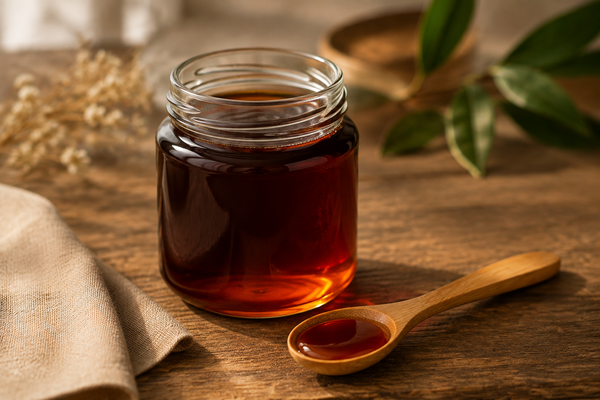
No single visual or sensory test can prove that a jar contains authentic mad honey. Colour varies naturally between harvests, with some jars noticeably darker and earthier than others from the same region, but appearance proves nothing about origin or composition. Storage, moisture, other nectar sources and the individual harvest all affect the finished honey.
Taste is equally limited as an authentication tool. Bitterness is sometimes associated with mad honey, but a bitter flavour does not reveal grayanotoxin concentration, and sweetness, aroma, thickness and crystallisation can all change without indicating whether the honey is genuine.
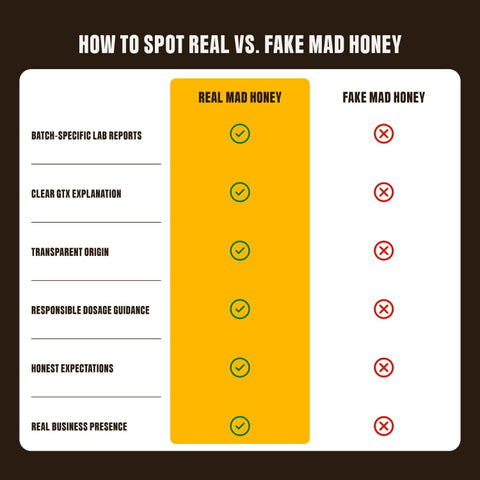
Even general honey authentication is scientifically complex. Researchers have noted that no single analytical method resolves every form of mislabelling or adulteration, which is why authenticity is better assessed through several connected signals:
-
A clearly stated country and harvesting region
-
A batch identifier connected to the jar being sold
-
Laboratory results showing relevant grayanotoxins
-
An explanation of the sourcing and handling process
-
Realistic language about natural variation and expected use
-
Accessible customer support, policies, and business information
One signal alone is not enough. A laboratory result without a matching batch number may not relate to the product being purchased, just as an origin story without testing leaves the grayanotoxin profile unknown.
What Information Should a Seller Provide?
A trustworthy seller makes the important information easy to find rather than leaving customers to search social media or request basic details after ordering. The product page should identify the country of origin and, where possible, the wider harvesting region, since broad descriptions such as "mountain honey" or "Himalayan honey" sound appealing but reveal very little about the actual source.
Supply arrangements deserve the same clarity. Whether the honey comes from wild cliff colonies, managed hives, or another arrangement is a meaningful detail, and specificity carries more weight than a romantic harvesting story with nothing traceable behind it. The landscapes and traditions behind each origin are worth understanding for context.
Batch information is another important signal. Wild honey changes between harvests, so a seller should be able to distinguish the current batch from older stock, and the batch reference on any report should correspond with the product actually supplied.
Responsible serving guidance belongs on the page before purchase rather than only inside the parcel. Mad honey should not be marketed around taking the largest possible amount or chasing the most intense response, and clear instructions, waiting periods and warnings show that a seller recognises the product's natural variability.
The ordinary details of any reliable online store matter too. Contact information, delivery terms, refund or return policies and a clear explanation of what happens if an order arrives damaged or falls short of expectations all belong in plain sight.
Why Batch Testing Matters
Batch testing turns broad marketing claims into information a customer can examine. The most relevant reports for mad honey measure grayanotoxins, particularly GTX I and GTX III, which are two of the principal compounds used to assess the profile of an individual harvest.
A useful report identifies the sample or batch analysed, the laboratory that performed the test, the testing date, the compounds measured and the concentrations detected. Most importantly, it relates to the batch currently on sale rather than an older sample that may no longer represent the available honey.
Testing does not make every harvest identical. Its purpose is to document natural variation and establish whether a batch falls within a seller's accepted standards. A responsible seller tests prospective batches for the relevant grayanotoxins, rejects those that fall outside those standards or produce inconsistent results, and publishes the corresponding laboratory information for the batch being sold.
A GTX report should not be treated as proof of every possible quality claim. Detecting GTX I and GTX III supports the presence of the compounds associated with mad honey, while separate analysis may be required to assess sugar adulteration, complete botanical origin, or other characteristics.

Red Flags When Buying Mad Honey Online
The clearest warning signs usually come from what a seller does not disclose. A store that repeatedly calls its honey the "strongest in the world" while providing no current laboratory report is the most familiar example, since potency claims are easy to write and difficult to verify without batch-specific evidence.
Guaranteed effects are another concern. Individual responses vary with the person, the serving amount, and the batch, so no seller can reliably promise that everyone will feel the same result within an exact period.
Vague origin language deserves the same scepticism. A product described as Himalayan without naming the country, harvesting region, or supplier relationship leaves the important question unanswered, and attractive photographs of cliffs and mountains establish nothing about where the contents of a particular jar originated.
Laboratory documents can also fall short. Missing dates, unreadable results, or no connection to the product batch all reduce a report to a trust badge rather than evidence.
Price provides context rather than proof. An unusually cheap product justifies closer inspection, because authentic mad honey is seasonal and difficult to source, but an expensive jar can still be poorly documented. Transparency matters more than the price tag.
The strongest concern is a combination of missing information. A seller with no traceable origin, no batch report, no responsible guidance, and no clear business presence is asking for trust in a label rather than in evidence.
How to Choose the Right Mad Honey Product
Once the seller has been assessed, the remaining decisions are narrower than they first appear. What is left to check is the batch on offer, the size that suits, and whether the guidance provided matches the way the honey will actually be used.
The batch is the first of those. A published report should carry a sample reference matching the jar on sale and a testing date recent enough to correspond to the current harvest, since a report from an older batch describes honey that is no longer in stock. Where a seller stocks more than one harvest, the reports are what distinguish them.
Jar size should reflect intended use. A smaller option allows a first-time buyer to assess the flavour and the overall experience before committing to a larger quantity.
Batch information should still guide the final decision, since country of origin alone does not determine potency. The published report and the accompanying serving guidance for the specific product on sale are the details that matter most, alongside the full safety and serving guidelines rather than only the instructions printed on a small label.

Best Place to Buy Mad Honey Online
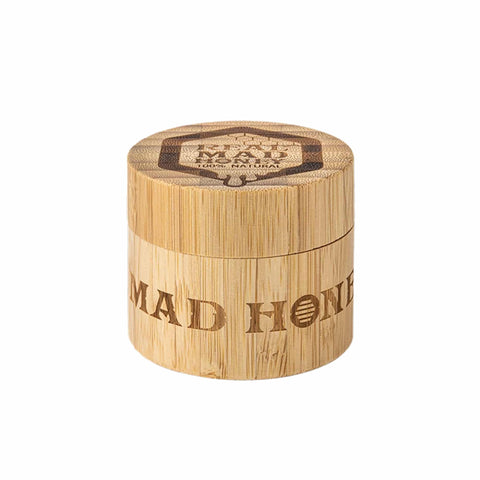
The best place to buy mad honey is a specialist seller that can connect the finished jar to its source, its batch, and its laboratory results. Real Mad Honey sources wild Himalayan honey through established Nepalese honey-hunting communities, harvested above 3,500 metres during the short seasonal windows when the rhododendrons bloom, and states plainly where each harvest came from rather than relying on general mountain branding.
Batch-level laboratory reports showing GTX I and GTX III results are published for the honey on sale. Prospective batches are assessed before purchase, and those falling outside the accepted standards or producing inconsistent results are rejected.
None of this presents every harvest as identical. The reports exist to show what was measured in an individual batch and to support more informed selection and serving decisions.
The sourcing process, serving guidance, and refund policy are all available to review before ordering, including the terms covering qualifying refund requests and returns of unopened jars. Together, these elements create a more complete basis for trust than appearance, reviews or potency language alone.
Conclusion: Buying Mad Honey With Confidence
Buying trustworthy mad honey is less about finding the most dramatic product than about finding the clearest evidence. Appearance and taste reveal the character of a harvest but cannot confirm its origin or grayanotoxin concentration, and those questions require transparent sourcing, batch identification, and laboratory analysis.
A reliable seller also communicates the product's limitations. Natural variation is expected, individual responses differ, and no responsible company guarantees an exact result.
The three details worth confirming before any order are where the honey was harvested, whether the laboratory report matches the available batch, and whether serving guidance is provided openly. When those are missing, the safest decision is to keep looking. When they are present, the choice can be made on origin, flavour and batch characteristics rather than on a mystery jar and an impressive label.