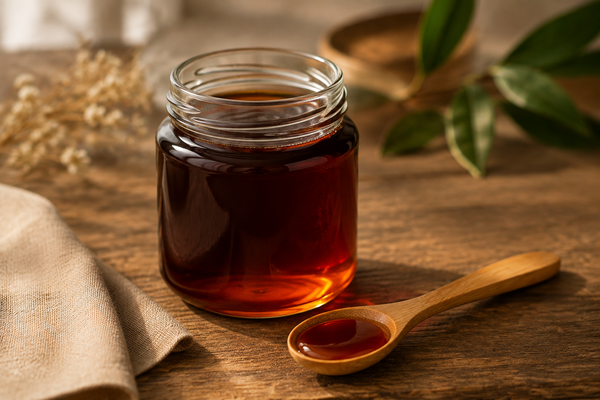
Mad honey occupies an unusual position among wellness products. It carries a genuine tradition, a documented pharmacology and a price several times that of ordinary honey, alongside a reputation built partly on podcast clips and viral video rather than on evidence.
Reviews reflect that split. Some buyers describe it as the most effective evening relaxant they have tried, while others report a jar that seemed to do nothing at all, and both accounts appear on the same product pages. Working out whether it is worth the money means separating the pattern from the noise.
What Buyers Say About the Taste
Taste is the one area where Trustpilot reviews converge almost completely. The flavour is described as bold and complex, sweet at first and then earthy, floral or noticeably bitter, with a texture thicker than most supermarket honey and a slight catch at the back of the throat shortly after swallowing. That throat sensation appears often enough across independent reviews to be treated as characteristic rather than as a fault.
Most reviewers rate the flavour as part of the appeal, describing it as unlike anything they had tried and worth experiencing on its own terms. Bitterness reflects the botanical source rather than any shortcoming in the honey, and what mad honey is and how it differs from regular honey explains where that flavour originates.
Colour is a less reliable signal than reviews often assume. Buyers frequently cite a reddish or deep amber tone as evidence of authenticity, but colour varies with floral source and storage rather than tracking potency.
What Buyers Say About the Effects
Trustpilot and Amazon reviews indicate a consistent set of sensations. Warmth spreading through the chest and limbs, a tingling on the lips or tongue, physical tension releasing, and a slower mental pace are the four that recur most often. Evening use is the dominant pattern, with better sleep and waking without grogginess mentioned repeatedly across seller review pages.
Mild mood elevation appears almost as often, usually described in modest terms such as a warm glow or a quiet contentment rather than anything dramatic. A smaller number of reviewers mention slightly heightened senses, with colours or sounds seeming richer, and those accounts are consistently described as subtle.
The unfavourable reviews follow their own pattern, and it is a revealing one. Reports of dizziness, nausea or feeling unwell almost always come from buyers who describe taking a tablespoon or more, working through most of a jar, or treating the honey like a dessert spread rather than a measured serving. The complaint in these cases is about quantity rather than about the honey, since the compounds behave predictably and the response scales with how much is taken. Reviewers who stay at a single teaspoon and wait before considering more rarely report anything unpleasant at all, which is why every credible seller publishes conservative guidance.
Independent coverage matches that picture. CNN Travel joined a beekeeper harvesting deli bal in Turkey's Black Sea region and described the same markers buyers report: a herbal bitterness beneath the sweetness and a burning heat catching the back of the throat, with the beekeeper noting that no hallucination is involved and that a teaspoon is the conventional amount. That measured account is closer to the typical positive review than the viral framing suggests.
Why Some People Report Feeling Nothing
A recurring theme across seller review platforms is not that the effects were too strong but that they never arrived. Buyers report a spoonful, then several, and nothing at any point, and this appears across nearly every seller with a public review page. Three things sit behind those accounts, and only the first is a genuine fault.
| Possible factor | What the buyer notices | What to check |
|---|---|---|
| Honey with no meaningful grayanotoxin content | Little or no noticeable response | Whether a current batch-specific laboratory report is available |
| A naturally milder harvest | A subtler response than expected | Checking the measured GTX figures for that batch |
| Timing and individual sensitivity | A different response from other buyers using the same batch | Follow the serving guidance, allow sufficient time, and avoid stacking servings |
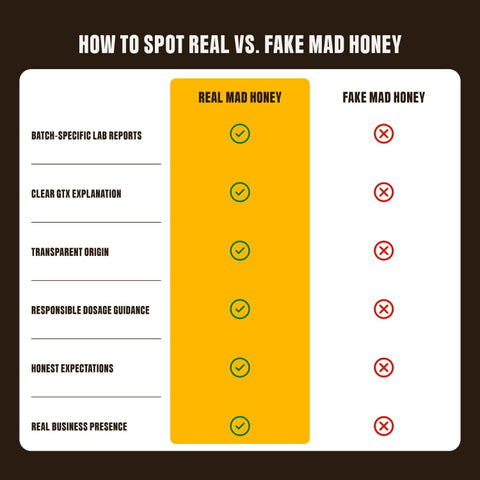
The first row is the one that produces the reviews describing a whole jar with no reaction whatsoever, and it is a seller problem rather than a product one. Several such reviews specifically mention that no batch information came with the purchase, which is the common thread. Colour, price and origin claims cannot distinguish honey that contains the compounds from honey that never did.
The other two are ordinary characteristics of a wild product rather than faults. A milder harvest is still doing exactly what it should, and the published figures for that batch set the expectation before the jar is opened. Sensitivity and timing shift the degree of response rather than removing it, and both become predictable once the strength of the batch is known.
What Researchers Say
Mad honey is better studied than most wellness products of its kind, which is unusual and worth weighing. Grayanotoxins have been analysed in laboratory settings for decades, and a 2025 review in the Journal of Applied Toxicology sets out the mechanism in detail: the compounds act on voltage-gated sodium channels, prolonging depolarisation and shifting autonomic balance toward the parasympathetic state associated with rest.
That matters for a review, because it means the effects buyers describe are not placebo. Warmth, physical relaxation and a slower mental pace correspond to documented physiological changes rather than to expectation alone, which distinguishes mad honey from a great many products sold on similar promises.
The same literature explains why servings are measured in fractions of a teaspoon rather than spoonfuls, and why responsible sellers publish conservative guidance. It also identifies who should not use it at all: anyone with a heart condition, low blood pressure or a prescription for blood pressure medication, and anyone pregnant. Those are firm exclusions rather than cautionary notes, since the cardiovascular mechanism interacts directly with those conditions.

How Mad Honey Became Popular
Modern Western interest grew substantially through documentaries, travel reporting, and podcast coverage. National Geographic documented a Kulung honey hunt in Nepal for its 2017 feature and the accompanying film The Last Honey Hunter, following harvester Mauli Dhan Rai on bamboo ladders three hundred feet above the ground, and Vice produced a documentary on a Gurung village's spring hunt in the Annapurna range. Both treated the subject as culture and livelihood rather than as a product.
Podcast coverage introduced it to a much wider audience. On episode 1925 of The Joe Rogan Experience, filmmaker Will Sonbuchner of Best Ever Food Review Show produced a jar he had brought back from a harvest in Nepal, and both he and Rogan tried about half a spoon on air. Their immediate reaction was the same marker that recurs in customer reviews and in the CNN account: a catch at the back of the throat, described as itchy and faintly like a reaction to a hot pepper. Rogan's verdict after a few seconds was that it definitely feels different from regular honey. The clip circulated widely and brought mad honey to an audience that had never encountered it.
What the footage conveyed better than the podcasts did was the work behind the jar. Harvests come from cliff faces reached by rope and bamboo ladder, during flowering windows that last weeks rather than months, and that difficulty is a large part of what separates mad honey from anything else on a shelf
Is Mad Honey Worth the Price?
Price is the other recurring theme among customer reviews, and the objection deserves a fair answer. Mad honey sits at the higher end of the honey market, though the comparison is often drawn against the wrong benchmark. Single-origin manuka, raw wildflower and other specialist honeys command high prices too, and anyone already buying honey at that level will find mad honey less of a departure than the headline figures suggest.
Three factors support the cost. The harvest is genuinely limited, with wild cliff colonies accessible only during specific flowering periods and the collection itself demanding. Volumes are small, and National Geographic reported wholesale prices well above those of ordinary Nepali honey long before the recent surge in Western demand. Serving size changes the arithmetic most of all, since the honey is taken a teaspoon at a time rather than spread on toast, which makes a modest jar last far longer than its weight implies and brings the cost per serving closer to everyday territory than the shelf price does.
The argument against paying a premium is simpler. An expensive jar with no batch information is not a better purchase than a cheap one, because neither can demonstrate what it contains, and price alone guarantees nothing.

Who Finds It Worth It
The reviews that describe mad honey as worth the money share a recognisable profile. These buyers use it in small amounts in the evening, value the calm and the sleep rather than any intensity, treat the taste and the tradition as part of what they are buying, and bought from a seller that documented what was in the jar. Expectations set at that level are usually met.
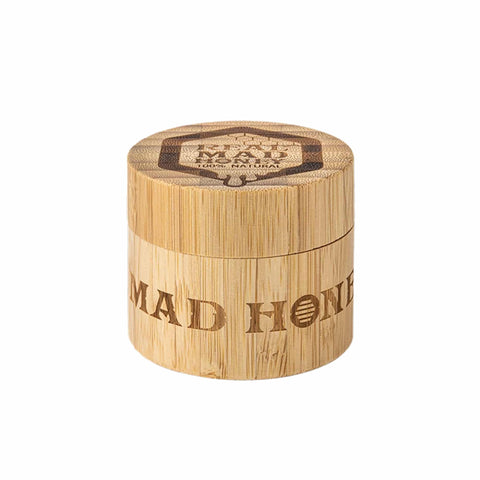
Customer reviews of Real Mad Honey follow that pattern closely. Across several hundred reviews on Trustpilot, the recurring themes are relaxation and improved sleep without grogginess, a calmer mood and better focus during the day, the natural character of the honey and the quality of the packaging. One reviewer describes using it nightly and finding it the best relaxation available, with the day's stress lifting and sleep following easily. The criticisms are equally consistent, centring on price and on the fact that a jar taken in half-teaspoon servings is a considered purchase rather than an impulse one.
Documentation is what makes that consistency possible. The honey is wild-harvested above 3,500 metres in the Himalayas through established Nepalese honey-hunting communities, third-party laboratory results for GTX I and GTX III are published against the batch on sale, batches falling outside the accepted standards are rejected, and conservative serving guidance ships with each jar. Together, those address the failure mode behind most disappointed reviews: honey with nothing in it, bought with no way to know in advance.

Verdict: Is Mad Honey Worth Buying?
The verdict is favourable, and it rests on something firmer than enthusiasm. Warmth through the chest, physical tension releasing, a slower mental pace, and easier sleep. The mechanism behind it is documented in the scientific literature rather than inferred from testimonials, which puts mad honey in a small minority of natural wellness products that can explain why they work.
The condition attached to that verdict is straightforward. Everything depends on the jar containing what it should, and that single variable separates the reviews calling it transformative from the reviews calling it sugar. Batch testing is not a nice-to-have detail on a product page; it is the difference between buying mad honey and buying honey. A seller who publishes measured results for the harvest on sale has answered the only question that genuinely matters, and one who does not is asking for money on the strength of a label.
For anyone who wants a distinctive evening ritual with real physiological weight behind it, taken in small amounts and bought with evidence attached, mad honey is worth both the money and the attention. What it will not do is deliver the version circulating in viral clips, and nobody should buy it expecting that. Judged on what it actually is, a rare, traditional, measurably active honey, it is one of the more interesting things available in the category.