Mad honey sells for considerably more than ordinary honey, and the range is wide enough to confuse anyone comparing jars. Small jars carry the highest cost per gram, larger ones bring it down sharply, and the same weight of honey can differ in price by a factor of three from one seller to the next.
That spread reflects a product which cannot be farmed, scaled or produced to order, and a market where some sellers test what they sell, and others do not. Understanding where a price sits, and why, matters more here than in almost any other food category.
What a Jar of Mad Honey Typically Costs
Pricing tracks jar size closely, and the per-gram cost drops sharply as volume increases. Small jars sit at the top of the per-gram scale, because packaging, testing, and shipping costs are spread across the smallest quantity of honey, while larger jars bring that figure down substantially. Most sellers stock somewhere between 50g and 500g, and a first purchase usually starts at the smaller end.
Across the wider market, mad honey generally sells for somewhere between roughly £15 and £65 per 100g, or around £150 to £350 per kilogram at the wholesale end, with the spread driven by origin, harvest altitude, batch rarity, laboratory testing and packaging. Sellers shipping directly from Nepal without testing or European warehousing occupy the lower half of that band, while tested, traceable honey sold with published batch results sits toward the upper half.
For comparison, ordinary British honey sells for roughly £7 to £10 for a 454g jar, and premium single-origin honeys command more without approaching mad honey territory. The gap is not a markup on the same product. It reflects a genuinely different supply chain.
Why Mad Honey Costs More Than Ordinary Honey
Conventional honey is farmed. Hives are placed, managed, harvested on a schedule, and replenished, which makes supply predictable and production scalable. None of that applies here, and the difference is what the price reflects.
Mad honey comes from wild colonies, and in Nepal those colonies build on exposed cliff faces reached by rope and bamboo ladder. Harvesting is seasonal, dangerous, and slow, with the main collection falling in late spring when the rhododendrons flower, and a smaller one sometimes following in autumn, and the work involved in a single harvest explains the cost better than any figure can.
Volume is the second constraint. A single harvest produces a limited quantity that cannot be topped up mid-year, which is why authentic sellers run out of specific batches rather than restocking on demand. Anyone advertising identical supply throughout the year is describing something other than a wild seasonal harvest.

What Changes the Price of a Jar
Four variables account for most of the difference between one jar and another, and none of them is about where the honey came from. Jar size is the largest, since per-gram cost falls steadily as volume rises, and it is the one the buyer controls outright.
Laboratory testing is the second, and it is the one buyers most often overlook. Independent batch analysis for GTX I and GTX III costs money for every batch, and sellers who publish those results carry that cost while sellers who make unverified claims do not. The difference shows up in the price and in nothing else visible on a product page.
Fulfilment accounts for the third. Honey warehoused in Europe with tracked delivery, customs handled, and a returns policy behind it costs more than a jar posted from Kathmandu with no recourse if it fails to arrive, and that difference buys recourse rather than honey.
Packaging is the smallest of the four but not nothing. Sealed jars, protective outer boxes and included dosage spoons add cost, and while presentation is easy to dismiss, the same packaging that makes a jar presentable is what stops it arriving cracked or leaking. Judging whether a price is fair is far easier with a clear understanding of what mad honey is and why its composition varies between one harvest and the next.
Price Per Jar Versus Cost Per Serving
The shelf price is the wrong number to judge mad honey by, because nobody consumes it like ordinary honey. Conventional serving guidance is a single teaspoon, roughly 5g, taken occasionally rather than daily, which means a jar contains far more servings than its size suggests and lasts far longer than its weight implies.
| Jar size | Servings at a 5g teaspoon | How long it lasts at two servings a week |
|---|---|---|
| 50g | 10 | Around five weeks |
| 100g | 20 | Around two and a half months |
| 150g | 30 | Around four months |
| 250g | 50 | Around six months |
| 500g | 100 | Around a year |
Seen this way, the arithmetic changes completely. A jar bought once tends to still be in the cupboard several months later, and the cost per serving lands well below what an equivalent evening ritual costs elsewhere, whether that is a glass of wine or anything else taken to mark the end of a day.
That is also why jar size is the single most effective lever on cost. Moving from the smallest jar to the largest roughly halves the price of every serving, which rewards anyone who already knows they like it and intends to keep one in the cupboard.
What a Cheap Jar Usually Means
A price far below comparable products deserves closer examination, but it does not prove that the honey is false or diluted. Lower prices may reflect direct international fulfilment, simpler packaging, older stock, limited testing or a different sourcing arrangement.
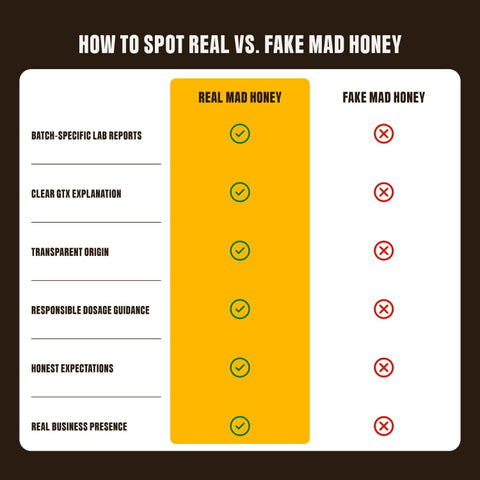
The important question is what the seller can verify. Check whether the harvesting origin is clearly identified, whether the available batch has relevant laboratory information and whether the company provides dependable delivery and customer-service policies.
A cheap jar without those details may carry more uncertainty, but price alone cannot establish authenticity, purity or potency.
Reviews across seller platforms bear this out. The complaint that recurs most often is not that a cheap jar caused problems but that it did nothing at all, which is the predictable outcome of paying below the cost of producing the real thing. The saving disappears the moment the jar turns out to be inactive.
Does a Higher Price Mean Stronger Honey?
Price and potency are not connected, and treating them as though they are leads buyers in the wrong direction. Grayanotoxin concentration is set in the field by the rhododendron species, the elevation, the season, and how much of the forage came from those flowers, and none of those variables appears on a price tag. A costly jar from an untested seller is exactly as unknown as a cheap one.
What a higher price can indicate is the cost of doing the work properly, meaning traceable sourcing, batch-level laboratory analysis, a rejection standard for batches that fall short, proper storage, and a real business behind the transaction. Those things cost money, and they show up in the price, but they are worth paying for because of what they prove rather than because of what they cost.
The practical consequence is that price belongs in the decision only after testing has been confirmed. Among sellers publishing batch results, comparing prices is a sensible exercise. Among sellers who publish nothing, the cheapest and the most expensive jar carry precisely the same risk.

What Good Value Looks Like
Value in this category means knowing what a jar contains before the money changes hands. Real Mad Honey publishes third-party laboratory results from Eurofins for GTX I and GTX III on every batch offered, rejects batches that fall outside its standards, and ships each jar with clear serving guidance, which is what converts a wild seasonal product into a known quantity.
As of July 2026, the range runs from a 50g jar at £37.50 through to 500g at £189.95, with the per-gram cost falling from £0.75 to £0.38 across that span. Applying the teaspoon arithmetic above, that works out at £3.75 a serving for the smallest jar and £1.90 for the largest. The smaller jars suit a first purchase, where the point is to judge the flavour and the experience before committing further, while the larger options are the better arithmetic for anyone who already knows they want it in the cupboard.
Each of the three cheap-jar problems described earlier has a corresponding answer here. Batches showing insufficient grayanotoxin content are rejected rather than sold, the honey is neither blended nor processed to stretch volume, and sourcing runs through named harvesting communities rather than anonymous bulk supply. The published report is what makes those claims checkable instead of merely stated.
Sourcing sits behind those figures rather than beside them. The honey is wild-harvested above 3,500 metres in the Himalayas by established Nepalese honey-hunting communities, during short seasonal windows that cannot be extended to meet demand, and the tradition behind those harvests accounts for a substantial part of what the price represents. A 60-day satisfaction guarantee covers the rest, including returns of unopened jars, which answers the question a pricing page inevitably raises: what happens if the money is spent and the jar disappoints?
Conclusion: What a Real Jar Should Cost
A genuine jar of mad honey costs meaningfully more than any supermarket honey, and where it sits within the market range depends mostly on jar size and on whether the seller tests what it sells. Anything substantially below the going rate deserves scrutiny rather than enthusiasm, because the economics of cliff harvesting leave very little room underneath it.
The figure that matters is not the one on the label. Cost per serving is the honest measure for a product taken a teaspoon at a time, and by that measure mad honey is considerably more accessible than its shelf price suggests, particularly in the larger jars where a single purchase can last most of a year.
What price cannot tell anyone is whether the honey works. That question is settled by a batch report and nothing else, which makes published laboratory results the first thing to check and the price the second. A tested jar at a fair price is good value. An untested jar at any price is a gamble with better packaging.