Key Takeaways
- Most mad honey comes from Nepal's Himalayas, with a smaller historic tradition on Turkey's Black Sea coast.
- Grayanotoxin honey has also turned up in the Caucasus, the Alps, North America, East Asia, and even a tropical island.
- Rhododendrons are the usual source, but relatives like mountain laurel can carry grayanotoxin into honey too.
- Mad honey needs whole hillsides of the right flowers and bees that feed mainly on them.
- Most of these honeys turn up by accident, in tiny amounts, and are never tested.
People usually tie mad honey to one place: the cliffs of the Himalayas. But the plants behind it grow on almost every continent, and now and then, bees find them somewhere unexpected.
Mad honey is found mainly in the Himalayas of Nepal, with a long tradition on Turkey's Black Sea coast too. Beyond those two regions, honey containing grayanotoxin has turned up in the Caucasus, the Alps, parts of North America, East Asia, Brazil and even Réunion Island in the Indian Ocean. In most of these places, it appears only rarely, in small amounts, and often entirely by accident.
Why Nepal Is the Home of Mad Honey
Nepal is among the few places on earth that have everything mad honey needs. Its steep Himalayan slopes are covered in rhododendron forests that bloom together in spring, turning whole hillsides red, pink, and white. Living alongside them is the Himalayan giant honeybee, the largest honeybee in the world, which builds its nests on sheer cliff faces close to those flowers.
Then there are the people. Nepal's honey hunters have harvested from these cliffs for generations, and they know exactly when the spring honey is ready and how much respect it deserves. The flowers, the bees, and that local knowledge together make Nepal the true home of mad honey, and it's where our honey comes from. The Himalayan rhododendrons carry grayanotoxin, the compound behind mad honey, into every harvest.
The only other place with a long mad honey tradition is Turkey's Black Sea coast, made famous in history when Greek and Roman soldiers stumbled across it more than 2,000 years ago.
A Surprising World Tour of Mad Honey
Outside Nepal and Turkey, mad honey is a rare find, which is exactly what makes the rest of the map so interesting.
Beyond Nepal in the Himalayas
Most of the world's mad honey still comes from Nepal, though, where honey hunting has the longest and best-known tradition. But Nepal's rhododendron forests don't stop at the border. The same mountain range stretches east through neighbouring countries, and the Himalayan giant honey bee lives along much of it. In places where the right rhododendrons grow densely and the bees feed on them in spring, the conditions for mad honey are much the same.
The Caucasus Mountains
Between the Black Sea and the Caspian, the Caucasus Mountains are home to wild rhododendrons that flower across the hillsides in spring.
The region is also famous among beekeepers for the Caucasian honey bee, prized for its gentle nature and unusually long tongue, which lets it reach deep into flowers. In places where these bees forage on rhododendrons, their honey can carry grayanotoxin, and accounts suggest some local beekeepers have long known which hillsides produce it.
The Alps and Southern Europe
Even the Alps have rhododendrons. Small alpine species, often called alpine roses, grow on the high mountain meadows of Switzerland, Austria, and their neighbours, and honey from these meadows is a local speciality. Most of it is perfectly ordinary honey, but grayanotoxin has occasionally been detected in local honey in Austria, Germany, and Switzerland, a reminder that the compound can turn up where few people expect it. Further south, wild rhododendrons also grow in parts of Spain and Portugal.
The Appalachian Mountains and Beyond
In the eastern United States, the plant to watch isn't a rhododendron but a close relative, mountain laurel. It grows across the Appalachian Mountains, and its nectar can contain grayanotoxin. Honey made largely from mountain laurel has been found to carry it, especially in seasons when bees have few other flowers to choose from. On the other side of the continent, grayanotoxin has been identified in honey from a mountain near Vancouver in Canada. Grayanotoxin honey was being recorded in North America as far back as the 1800s.
Japan, Korea, and China
East Asia has its own rhododendrons, along with pieris, a shrub also known as Japanese andromeda, which belongs to the same plant family and contains grayanotoxin too. Honey containing grayanotoxin has occasionally turned up in Japan, Korea and China over the years. In most cases, the honey was local, wild, and untested, and nobody realised what it contained until it was tested.
A Tropical Surprise on Réunion Island
The most unexpected spot on the map is Réunion, a small volcanic island in the Indian Ocean, far from any snowy mountain range. Local wild honey there has also been found to contain grayanotoxin. It's a good example of how widely grayanotoxin-producing plants have spread and how bees will find them wherever they grow.
Why You Won't Find These Honeys in Shops
As fascinating as these places are, nobody is harvesting mad honey from the Alps or the Appalachians on purpose. In most of them, grayanotoxin ends up in honey by accident, when bees happen to feed heavily on the wrong flowers in a particular season. The amounts are usually small, the honey is often mixed in with ordinary honey, and it's almost never tested. In many of these places, the people who harvested or bought the honey had no idea it contained grayanotoxin at all.
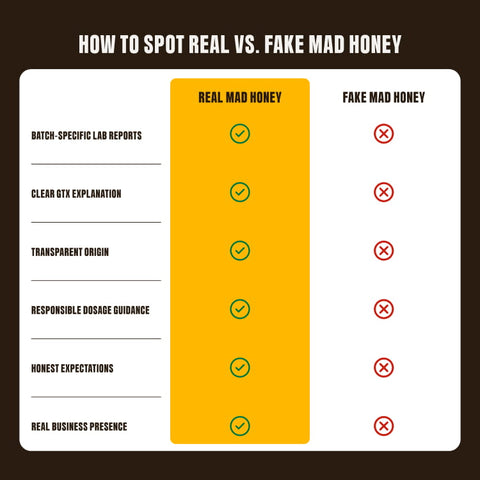
That's the real difference between a curiosity and a product. When the strength of a honey is unknown, there's no way to take it with confidence. We have every batch of our honey tested by an independent laboratory and publish the results in our batch lab reports. Every jar of our mad honey can be matched to its report, so you know exactly what you're getting.

Final Thoughts
Honey containing grayanotoxin has turned up in some surprising places, from alpine meadows and Appalachian hillsides to a volcanic island in the Indian Ocean. It's a good reminder of how widely these flowers grow and how good bees are at finding them.
Most of those honeys, though, are one-off accidents rather than traditions. Mad honey as people know it, gathered deliberately, harvested with care, and treated with respect, still belongs to the mountains. In Nepal, it's a story of rhododendron forests, giant cliff bees, and honey hunters who have been reading those cliffs for generations.